


A home inventory business can start with a smartphone, a simple offer, and a platform that turns property documentation into a repeatable service.
If you want to start a home inventory business without hiring employees, the opportunity is straightforward: homeowners, renters, landlords, real estate agents, estate planners, and insurance professionals all need reliable records of personal property before a loss, move, estate event, or short-term rental turnover.
This guide shows how to launch a home inventory business with a platform-first model, low upfront cost, and Workhint as the operating foundation.
What’s in this article?
- Why a home inventory business works
- What you need before taking the first customer
- How to price home inventory services
- How to find first customers and referral partners
- How Workhint can help you launch the operating platform
- A first 7-day launch plan, checklist, and FAQ
Why this business works
Home inventory services solve a practical problem most people postpone. A detailed record can help with insurance claims, estate planning, moves, divorce documentation, short-term rental setup, and landlord furnished-property records. The service is valuable because customers usually need accuracy, speed, and organization more than they need a complex consulting engagement.
That gap is where a platform-first model matters. Instead of doing every visit yourself forever, you can start with one city, one simple offer, and a small provider network. Providers capture the inventory. Your platform manages requests, appointments, checklist standards, review, report delivery, payment, and provider payout.
What you need to launch
Keep the first version lean. The goal is to validate demand, not to build a large company before anyone has paid you. Start with a branded customer platform, a documented service process, basic insurance, a repeatable report template, and a way to recruit reliable independent providers.
| Launch item | Lean first version | Estimated cost |
|---|---|---|
| Business setup | Business name, entity, bank account, basic contract review | $100 to $700 |
| Branded platform | Customer intake, scheduling, forms, approvals, payments, provider workflow | Start lean before custom software |
| Documentation tools | Smartphone, cloud storage, inventory app, checklist template | $0 to $100 per month |
| Insurance | General liability and professional liability where appropriate | Varies by state and coverage |
| Provider onboarding | Training checklist, sample report, independent contractor agreement | $0 to $300 |
| Customer acquisition | Local landing page, referral outreach, simple ads or flyers | $50 to $500 |
Check local requirements before taking paid work. Some states or customer segments may expect certification, specific insurance, or rules around valuations. If you provide valuation support, be clear about whether you are documenting replacement estimates, not acting as a licensed appraiser unless you are qualified to do so.
How to price it
Home inventory pricing should be simple enough for customers to understand and structured enough for providers to execute. Start with packages based on property size and service depth. Add recurring update plans for customers who need annual or semiannual refreshes.
| Offer | Best for | Example price |
|---|---|---|
| Apartment inventory | Renters, small condos, moving documentation | $150 to $250 |
| Standard home inventory | Homeowners documenting major belongings | $300 to $500 |
| Estate or high-value inventory | Executors, estate planners, larger homes | $600 to $1,200+ |
| Short-term rental setup | Airbnb and furnished rental operators | $250 to $700 |
| Annual update plan | Customers who want records kept current | $99 to $300 per year |
Protect margin by separating field capture from final review. A provider can visit the home, follow the checklist, capture required media, and submit the record. You or a trained reviewer can approve the report before delivery. That lets the business scale without immediately adding payroll.
How to get first customers
The first customers usually come from trust-based channels. Start with people who already advise homeowners when documentation matters: insurance agents, real estate agents, estate attorneys, financial planners, senior move managers, professional organizers, short-term rental managers, and local property managers.
- Create a one-page offer for homeowners preparing for insurance documentation.
- Ask insurance agents whether clients struggle to document belongings after a claim.
- Partner with estate planners and probate attorneys who need orderly asset records.
- Offer a short-term rental inventory package for hosts and co-hosts.
- Post before-and-after examples of anonymized inventory reports in local groups.
- Run a small founding-customer offer to validate pricing before expanding.
How Workhint helps launch it
Workhint can become the branded operating platform for the home inventory business before you invest in custom software or staff. A customer submits a request through your branded portal, selects the property type, uploads basic details, chooses the inventory package, and books a time. The system can route the request to an available independent inventory provider based on location, availability, and skill level.
The provider receives the assignment, follows the mobile checklist, captures room-by-room photos and notes, uploads documents, flags exceptions, and submits the work for review. Your operations dashboard tracks every request from intake through scheduling, field completion, quality approval, report delivery, invoice payment, and contractor payout.
That matters because the business depends on consistency. Customers are not buying a random set of photos. They are buying a reliable record. Workhint helps you standardize the work, manage provider onboarding, collect forms, route approvals, keep customers updated, take payments, pay contractors, and see which referral channels are producing profitable jobs.
First 7-day launch plan
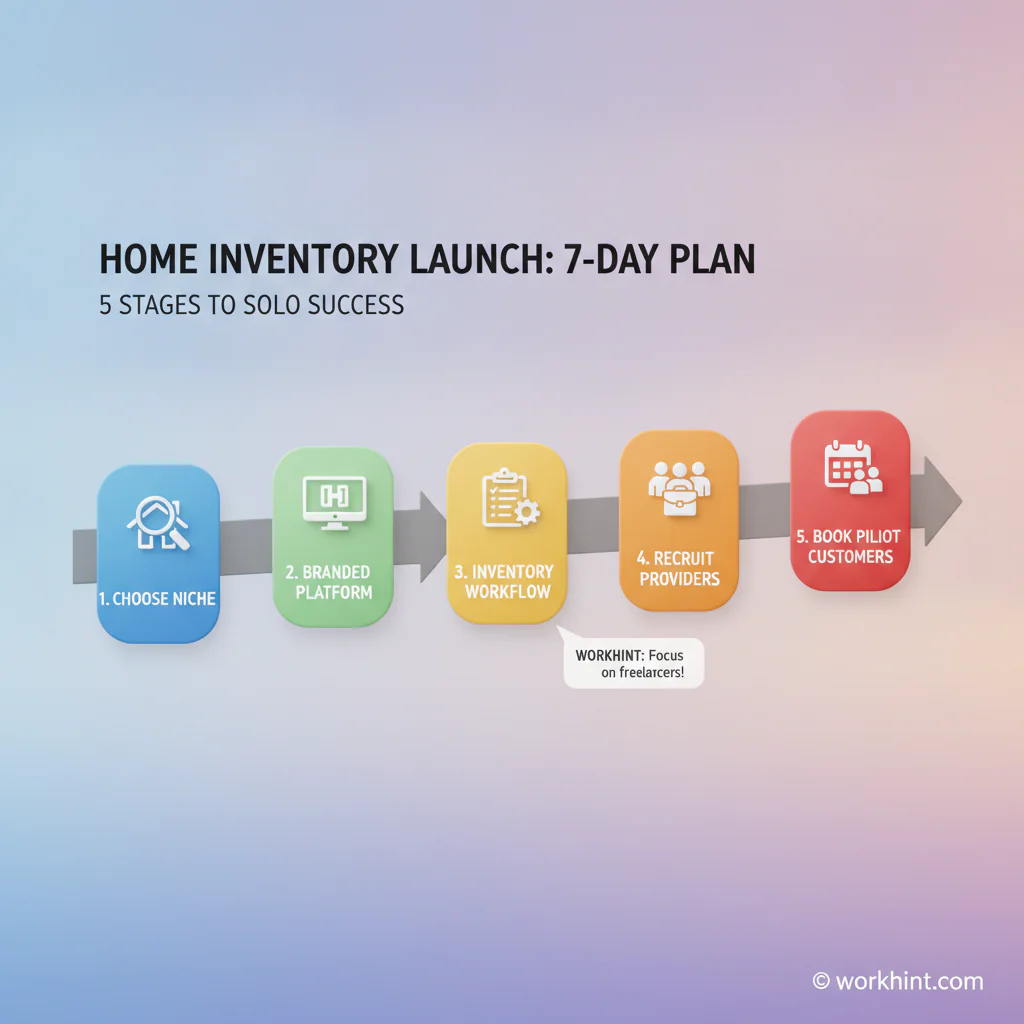
- Day 1: Choose one customer segment, such as homeowners, short-term rental hosts, or estate professionals.
- Day 2: Set up the branded Workhint platform basics: intake form, customer portal, service packages, and request dashboard.
- Day 3: Build the inventory checklist, quote approval, scheduling, payment, and provider payout process.
- Day 4: Recruit two to five independent providers or resource partners who can capture property data professionally.
- Day 5: Contact referral partners with a simple offer and sample report outline.
- Day 6: Book first conversations or discounted pilot requests and run them through the platform.
- Day 7: Review demand, pricing, provider performance, and report quality before spending more.
Final launch checklist
- Choose a clear home inventory niche and launch market.
- Register the business and check local requirements.
- Create service packages with clear deliverables.
- Set up a branded Workhint customer request and scheduling flow.
- Create room-by-room capture checklists and quality standards.
- Recruit initial independent inventory providers or local service partners.
- Set payment, refund, report delivery, and contractor payout rules.
- Build a referral list of insurance agents, estate planners, organizers, and real estate professionals.
- Validate demand before hiring employees or buying expensive tools.
FAQ
How much does it cost to start a home inventory business?
A lean launch can often start with a smartphone, basic business setup, insurance, a branded intake system, and simple marketing. Costs vary, but the first version can be much cheaper than a traditional office-based service business.
Do I need certification to offer home inventory services?
Requirements vary by location and by the type of work offered. Check your state rules, insurance expectations, and whether valuation or appraisal work requires a separate credential.
Can I start a home inventory business with no employees?
Yes. You can begin as the operator and later use independent providers for field capture while keeping customer intake, quality review, payments, and report delivery inside your platform.
Who buys home inventory services?
Common buyers include homeowners, renters, landlords, short-term rental hosts, estate planners, probate attorneys, real estate agents, financial planners, and insurance-related referral partners.
What equipment do I need?
Start with a good smartphone, cloud storage, a repeatable checklist, and inventory reporting tools. Upgrade cameras, scanners, and specialty tools only after paying customers justify the investment.
How do home inventory businesses make money?
Revenue usually comes from one-time property inventories, larger estate or moving projects, short-term rental documentation, and recurring update plans for customers who want records refreshed regularly.
What should beginners avoid?
Avoid overbuilding before demand is proven. Do not hire staff, lease space, or create custom software until you know which buyer segment pays, what they expect, and how the work will be delivered consistently.
Conclusion
A home inventory business is attractive because it turns a neglected but important task into a practical service. The lean path is to validate demand first, build a branded platform, recruit a small provider network, and standardize the work before investing heavily.
Workhint makes that path easier by giving the business an operating foundation from day one: customer requests, scheduling, provider workflows, approvals, payments, contractor payouts, and reporting in one branded system.
Leave a Reply