


Before an international contractor is paid, finance needs proof of status, clear ownership, and a record trail that will survive review.
The W-8BEN form for international contractor payments is not just a tax document. For finance and operations teams, it is a payment control. It tells the payer that a foreign individual is certifying foreign status for U.S. tax withholding and reporting purposes, and it gives the business a document to keep with contractor records before money starts moving.
This article is educational, not tax advice. Rules can change, and edge cases depend on facts such as where the work is performed, what type of income is paid, whether treaty benefits are claimed, and whether the payee is an individual or entity. Use this as an operating workflow, then confirm sensitive decisions with a qualified tax advisor.
What’s in this article?
- When finance teams should collect a W-8BEN before payment
- How W-8BEN differs from W-8BEN-E and W-9
- A payment readiness workflow for international contractors
- Common controls, exceptions, and recordkeeping mistakes
- Where Workhint fits when contractor payments need repeatable approval
Why W-8BEN matters for contractor payments
The IRS describes Form W-8BEN as a certificate foreign individuals give to a withholding agent or payer when they are the beneficial owner of an amount subject to withholding. In plain finance-operations terms, the form helps the payer document that the contractor is not a U.S. person and should not be treated like a domestic contractor who provides a W-9.
That distinction matters before payment. If a finance team pays international contractors without a consistent documentation step, it can create confusion during year-end reporting, audits, vendor reviews, or withholding analysis. The real operational risk is not only choosing the wrong payment rail. It is approving payouts while tax status, entity type, work location, and documentation ownership are unclear.
W-8BEN vs W-8BEN-E vs W-9
The most common mistake is treating every contractor tax form as interchangeable. They are not. The form should match the payee’s status and business structure.
| Form | Common use | Finance control |
|---|---|---|
| W-8BEN | Foreign individual certifying foreign status | Collect before paying a non-U.S. individual contractor when applicable |
| W-8BEN-E | Foreign entity certifying status | Use when the contractor or vendor is a foreign company, not an individual |
| W-9 | U.S. person providing taxpayer identification information | Use for U.S. vendors and contractors instead of a W-8 form |
The IRS says Form W-8BEN-E is used by foreign entities, while requester instructions for the W-8 family are published separately for withholding agents and payers. Finance teams should build the form decision into onboarding so AP is not trying to decide after an invoice is already approved.
A W-8BEN payment readiness workflow
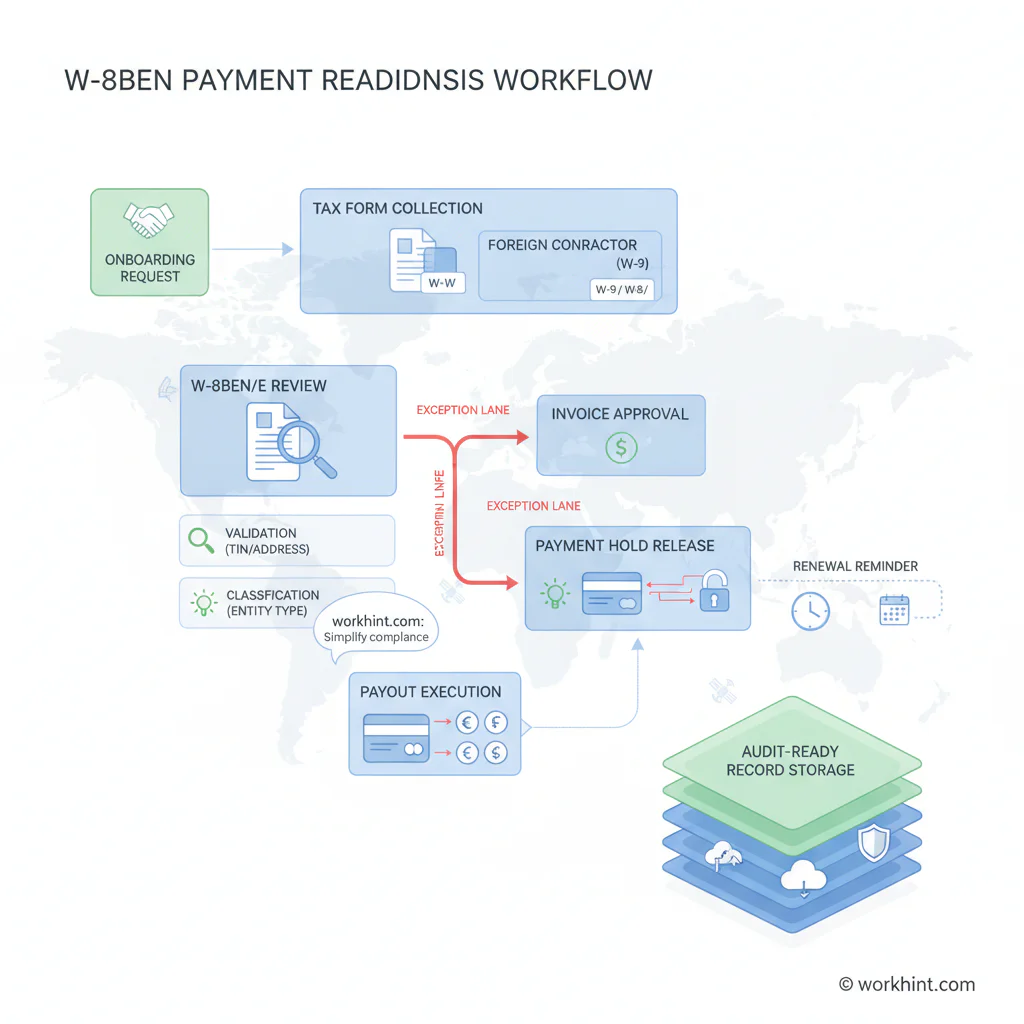
A practical workflow starts before the first invoice. The goal is to prevent a contractor from reaching payment approval until the basic tax-documentation questions have been answered.
- Create the contractor record. Capture legal name, country, individual or entity status, work location, payment currency, payment method, and internal owner.
- Select the expected tax form. Route individuals toward W-8BEN, foreign entities toward W-8BEN-E, and U.S. persons toward W-9.
- Collect the form before payment. Do not wait until the contractor has submitted an overdue invoice. Make documentation part of onboarding.
- Review obvious completeness issues. Check signature, date, name alignment, country fields, treaty claim fields when present, and whether the form type matches the payee type.
- Hold payment when status is unclear. Missing form, mismatched payee name, wrong form family, conflicting country data, or incomplete treaty details should create an exception before payout.
- Approve the invoice only after readiness is clear. The AP approver should see tax-documentation status beside contract, invoice, PO, bank, and payment approval status.
- Store the evidence. Keep the form, review date, reviewer, contractor record, payment record, and exception notes in a retrievable place.
- Track renewals and changes. A contractor’s status, residence, or structure can change. Long-running contractor relationships need review dates, not one-time file uploads that disappear into a folder.
Payment controls finance teams should add
The W-8BEN workflow should be tied to payment status, not stored as a separate compliance chore. A good control model gives AP clear rules.
| Situation | Payment action | Owner |
|---|---|---|
| No tax form on file | Hold first payment | Contractor operations or AP |
| Individual submitted W-8BEN-E | Send back for correction | AP reviewer |
| Entity submitted W-8BEN | Escalate before approval | Tax or finance lead |
| Services may be U.S.-source | Review withholding and reporting | Tax advisor or controller |
| Contractor changed country or entity | Request updated documentation | Contract owner |
The IRS also publishes information on Form 1042-S and who must file information returns for certain payments to foreign persons. That does not mean every international contractor payment creates the same filing requirement. It does mean finance needs a documented review process instead of relying on memory at year end.
Common mistakes to avoid
- Collecting the form after payment. If payment has already gone out, finance loses leverage and may need cleanup later.
- Using W-8BEN for every foreign vendor. Foreign companies generally use W-8BEN-E, not the individual form.
- Ignoring who performed the work and where. Work location can affect sourcing and reporting analysis, so capture it during onboarding.
- Letting forms live outside the payment workflow. A form in email is not enough if approvers cannot see payment readiness.
- Skipping exception notes. If a payment is released after review, record who approved the exception and why.
Where Workhint fits
Workhint is useful when international contractor payments involve more than one person, approval, or document. A team can turn the W-8BEN process into a live workflow: contractor intake, form selection, document upload, reviewer assignment, payment hold status, invoice approval, exception routing, renewal reminders, and audit-ready records in one operating system.
That does not replace tax advice or payment infrastructure. It makes the work around the payment visible. Finance can see which contractors are ready to pay, which invoices are blocked, which documents are missing, and which approvals are aging before the payment run is due.
FAQ
Do all international contractors need a W-8BEN?
No. W-8BEN is generally for foreign individuals. Foreign entities usually use W-8BEN-E, and U.S. persons usually use W-9. The right form depends on the contractor’s status and payment facts.
Should finance collect W-8BEN before the first payment?
Yes, as an operating best practice. Collecting it during onboarding prevents AP from discovering missing documentation after an invoice has already been approved.
Does W-8BEN mean there is no withholding or reporting?
Not automatically. The form documents status and may support withholding treatment, but reporting and withholding depend on the income type, source, treaty claims, and other facts. Confirm edge cases with tax counsel.
How should the form be stored?
Store it with the contractor record, payment approvals, reviewer notes, and renewal reminders. Finance should be able to retrieve the evidence without searching inboxes or disconnected folders.
Conclusion
A clean W-8BEN process is a finance control, not paperwork for paperwork’s sake. When contractor onboarding, tax form review, invoice approval, payment holds, and recordkeeping are connected, international payments become easier to approve and easier to defend later. Start with the form, but build the operating workflow around it.
Leave a Reply