

A process serving business can start lean if you sell reliability first and build a local server network around demand.
If you want to learn how to start a process serving business, the fastest path is not renting office space or hiring a team first. It is choosing a tight launch market, setting up compliant intake and delivery, recruiting independent process servers where allowed, and proving legal buyers will send work through your platform.
Process serving is practical because legal documents still need reliable, documented delivery. Customers care about speed, proof, communication, and compliance. A platform-first model lets you manage those expectations before you overinvest in staff, vehicles, or custom software.
What’s in this article?
- Why process serving can work as a lean service business
- What you need before accepting jobs
- Startup costs and pricing
- How to find the first legal clients
- How Workhint can power the business from day one
- A 7-day launch plan and checklist
Why this business works
Process serving has clear demand. Attorneys, courts, property managers, private investigators, debt recovery teams, and legal service companies need documents served correctly and recorded carefully. They buy proof that service was attempted, completed, documented, and communicated on time.
The business fits a lean launch model because you can begin with one city, one service type, and a small network of qualified independent servers. Public pricing references commonly show standard process serving fees from roughly $50 to $150, with urgent or complex jobs priced higher.
The main risk is compliance. Rules vary by state, county, and case type. Some places require registration, certification, bonding, licensing, or court appointment. Confirm the rules before selling.
What you need to launch
You need a compliant operating model before you need a large team. Start with standard service for a defined local area, clear turnaround times, status updates, proof of service, and escalation rules for difficult serves.
| Launch item | Lean starting approach | Typical early budget |
|---|---|---|
| Business setup | LLC or local equivalent, EIN, bank account, basic contract templates | $100 to $800 |
| Licensing and registration | Confirm state, county, court, bonding, and certification requirements | $100 to $1,000+ |
| Insurance | General liability, errors and omissions, and auto coverage as appropriate | $500 to $2,000 per year |
| Branded platform | Client intake, document upload, assignment, status updates, invoicing, and payouts | Start lean, expand after demand |
| Essential field tools | Smartphone, mapping, secure document handling, printer access, mileage tracking | $200 to $1,000 |
| Provider network | Independent servers or legal support partners where permitted | Mostly time at first |
Do not buy a fleet, lease an office, or hire dispatchers before the job volume proves the need. The better first investment is a clean system for intake, assignment, evidence, customer communication, billing, and contractor payout.
How to price it
Price process serving around service level, geography, attempts, document complexity, and turnaround time. Standard, rush, same-day, difficult address, rural mileage, filing, and affidavit support should not all be treated the same.
| Offer | Best use | Example price |
|---|---|---|
| Standard local serve | Routine documents in your core service area | $60 to $125 per job |
| Rush serve | 24 to 48 hour turnaround when capacity exists | $125 to $225 per job |
| Same-day attempt | Urgent cases with fast dispatch | $175 to $300+ |
| Volume law firm account | Recurring clients with predictable work | Discounted per job or monthly billing |
| Filing and affidavit support | Clients that want administrative help after service | Add-on fee or bundled package |
Keep the first pricing sheet simple. Add complex zones, mileage rules, skip tracing, court filing, and subscription accounts after you understand demand. In the first month, track profit per job, travel time, completion rate, reattempt rate, and payment speed.
How to get first customers
The first customers are usually local and relationship-driven. Build a list of family law firms, eviction attorneys, civil litigation firms, collection firms, private investigators, property managers, legal document preparers, and legal support companies in your launch area.
Your outreach should focus on reliability, status visibility, turnaround times, and clean proof of service. Buyers need to know why your operation will reduce follow-up, missed updates, sloppy documentation, and last-minute scrambling.
Start with 25 to 50 local accounts. Offer a clear standard serve, rush option, and online request flow. The goal is to make sending a job easier than emailing documents back and forth.
How Workhint helps launch it
Workhint helps you launch the process serving business as a branded legal support platform instead of a spreadsheet, inbox, file folder, and payment link.
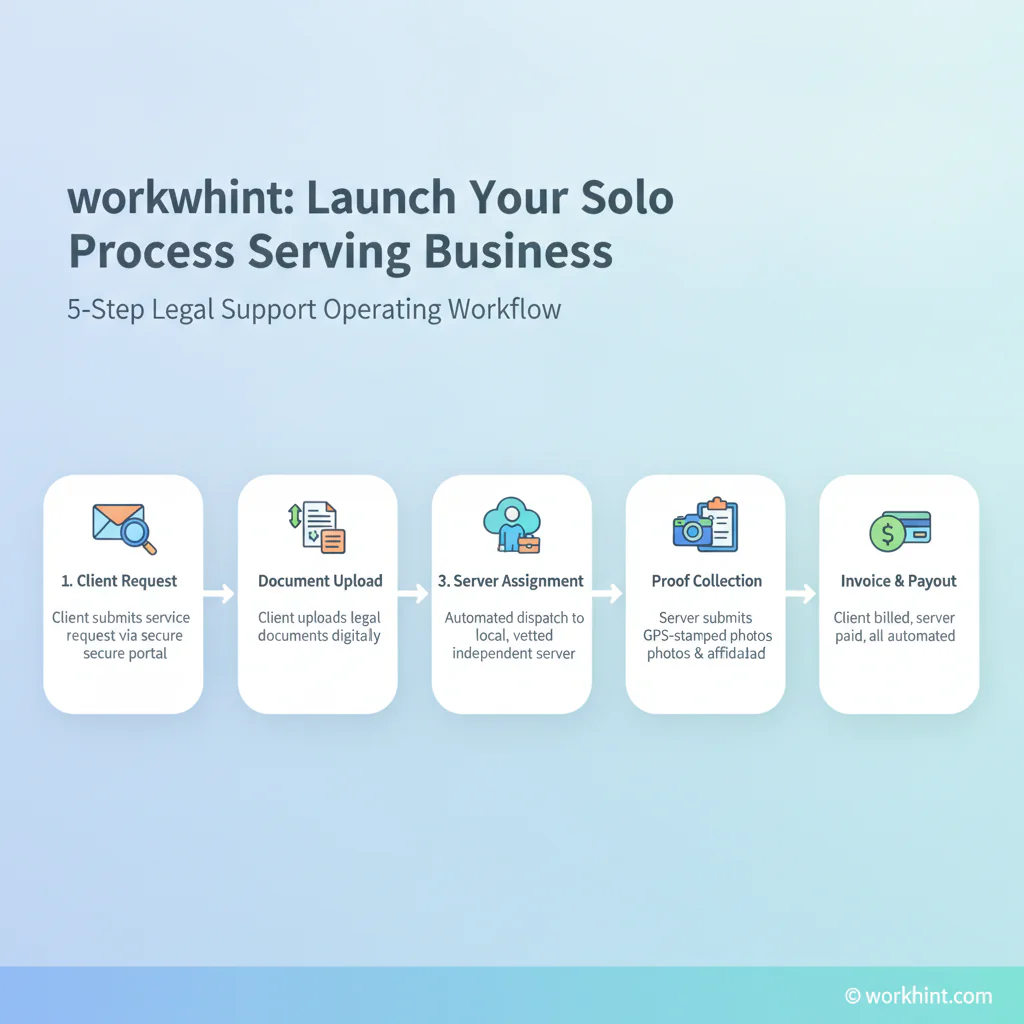
A law firm can submit a service request through your branded portal, upload documents, choose service level, enter addresses, approve pricing, and see status updates. Inside the operation, you can assign the job to an approved independent server, collect attempt notes, timestamps, location details, affidavit details, invoices, payments, and server payouts.
That operating flow matters because process serving depends on documentation. Workhint gives you a structured way to manage every job from request to proof of service without building custom software first. You can launch narrowly, recruit qualified providers, validate demand, and add cities only when the workflow is working.
How to start a process serving business in 7 days
- Day 1: Choose one launch area, confirm local process serving rules, and define the first service offer.
- Day 2: Set up the branded Workhint platform basics: intake, document upload, service levels, client dashboard, and internal job board.
- Day 3: Build the pricing sheet, quote approval process, assignment workflow, proof collection steps, invoicing, and payout rules.
- Day 4: Recruit three to five qualified independent process servers or legal support partners where local rules allow.
- Day 5: Contact local attorneys, property managers, investigators, and legal document preparers with one clear offer.
- Day 6: Route interested clients through the platform and test whether intake, assignment, updates, and proof collection work cleanly.
- Day 7: Review demand, compliance gaps, pricing, turnaround times, provider readiness, and whether to expand outreach.
A good first week should produce a compliant setup, provider conversations, and early buyer feedback. It does not need a large staff or a complicated brand.
Final launch checklist
- Choose the launch city or county.
- Confirm state, county, and court requirements before selling.
- Register the business and open a separate bank account.
- Set up insurance and bonding where required.
- Create standard, rush, and same-day pricing rules.
- Configure the branded Workhint client portal and request flow.
- Recruit approved independent servers or service partners where permitted.
- Create assignment, attempt tracking, proof, invoice, payment, and payout workflows.
- Contact the first 25 local legal buyers.
- Validate recurring demand before hiring employees or expanding markets.
FAQ
How much does it cost to start a process serving business?
A lean launch can often start with a few hundred to several thousand dollars, depending on licensing, bonding, insurance, field tools, marketing, and platform setup. Costs rise if your state requires more formal certification or if you invest in vehicles and staff too early.
Do I need a license to be a process server?
It depends on your state, county, and court rules. Some markets require registration, certification, bonding, or appointment. Check the rules before accepting jobs, especially if you plan to use independent servers.
Can I start a process serving business with no employees?
Yes, if local rules allow independent servers or qualified partners. You still need clear onboarding, compliance checks, assignment rules, documentation standards, and payout workflows so clients receive a consistent service.
How much should I charge for process serving?
Many standard local serves fall around $60 to $125, while rush, same-day, rural, difficult, or multi-attempt jobs can cost more. Price based on turnaround time, distance, attempts, complexity, and client volume.
Who hires process servers?
Common buyers include law firms, landlords, property managers, courts, collection teams, private investigators, legal document preparers, and legal support companies.
Is process serving profitable?
It can be profitable when routes are efficient, documentation is reliable, clients send repeat work, and pricing accounts for reattempts, travel, urgency, and administrative time.
Conclusion
The best way to start a process serving business is to keep the first version focused. Pick one market, confirm the rules, create a branded client platform, recruit qualified independent providers where permitted, and sell reliability before scale. Workhint gives you the operating foundation to manage requests, assignments, proof, payments, and payouts while you validate demand before making expensive commitments.
Leave a Reply