


You can start a senior placement agency as a trusted local matching platform before hiring a care team.
Learning how to start a senior placement agency is really about learning how to build trust, qualify families, and match seniors with the right living or care options. The lean version does not start with an office, employees, or a call center. It starts with one clear market, a branded intake process, and a small network of independent advisors or facility partners.
The demand signal is strong. The U.S. population age 65 and over reached 55.8 million in the 2020 Census, and aging households are comparing assisted living, memory care, independent living, in-home support, and respite options.
A senior placement agency can make that decision easier. Your job is to understand the family situation, explain options, coordinate tours, and help the family move from confusion to a good next step.
What’s in this article?
- Why a senior placement agency can work as a low-overhead service business.
- What you need before accepting the first family inquiry.
- How senior placement agencies usually price and earn revenue.
- How to get first customers through local trust channels.
- How Workhint can become the branded operating platform for the agency.
- A 7-day launch plan, checklist, and FAQ.
Why this business works
A senior placement agency works because the customer problem is urgent and emotional. Adult children may be comparing facilities while managing work, siblings, budgets, and medical concerns. A good advisor saves time and lowers the risk of a rushed decision.
The business also fits a provider-network model. You do not need to own care facilities or employ caregivers. You can build relationships with assisted living communities, memory care centers, home care providers, move managers, elder law attorneys, and discharge planners.
The simplest first offer is a local placement consultation: intake, needs assessment, budget review, shortlist creation, tour coordination, follow-up, and move-in support. Families buy it because the process is hard to navigate alone. Providers participate because qualified referrals can help them fill appropriate openings.
What you need to launch
Start with the operating model, not the office. Choose a clear niche, such as assisted living placement in one metro area or memory care referrals for families needing quick decisions.
You also need rules. Decide how you screen providers, disclose referral fees, protect family information, and refer families to licensed professionals when advice moves into legal, medical, financial, or care-plan territory. Requirements vary by state.
| Launch item | Lean budget | Why it matters |
|---|---|---|
| Business registration and basic legal review | $150 to $800 | Sets up the agency and clarifies referral agreements. |
| Insurance and professional liability review | $500 to $2,000 | Protects the business when advising families. |
| Branded Workhint platform | Lean platform cost | Handles intake, provider records, scheduling, approvals, and follow-up. |
| Local website and trust materials | $200 to $1,000 | Explains your service, process, disclosures, and local focus. |
| Provider research and relationship building | $0 to $500 | Builds the referral network before paid advertising. |
| Local outreach and partnerships | $200 to $1,500 | Creates first conversations with families and referral sources. |
Avoid early spending on an office, large ad campaigns, salaried coordinators, or broad software stacks. Validate family demand and provider acceptance first.
How to price it
Many senior placement agencies are paid by senior living communities or care providers after a successful move-in or accepted referral. The fee may be flat or a percentage of the first month’s rent or service value. Some agencies also offer family-paid consulting packages.
Be transparent. Families should understand who pays you and how you handle recommendations.
| Model | Example | Best use |
|---|---|---|
| Provider-paid placement fee | Flat fee or percentage after move-in | Assisted living, memory care, and senior living referrals. |
| Family-paid consultation | $150 to $500 for planning support | Families needing research, comparison, and decision support. |
| Concierge placement package | $750 to $2,500 for deeper coordination | Complex searches, urgent moves, or out-of-town adult children. |
| Partner referral fee | Agreed fee for qualified introductions | Move managers, home care providers, estate services, and related partners. |
Do not choose pricing only by what competitors charge. Choose a model that is legal in your market, clear to families, acceptable to providers, and sustainable for the work required.
How to get first customers
The first customers usually come from trust channels, not broad advertising. Start with elder law attorneys, discharge planners, social workers, downsizing real estate agents, faith communities, senior centers, home care providers, and financial advisors.
Build a simple local resource page for your launch market. Explain the difference between independent living, assisted living, memory care, respite care, and in-home support. Offer a clear intake form for families who want help comparing options.
Your first goal is not to look national. It is to prove that local families will ask for help, providers will respond, and your process can move an inquiry to a recommendation.
How Workhint helps launch it
Workhint lets you create the branded operating platform for the senior placement agency before you build custom software or hire coordinators. A family can submit a request, explain needs, upload notes, share budget constraints, and choose tour times.
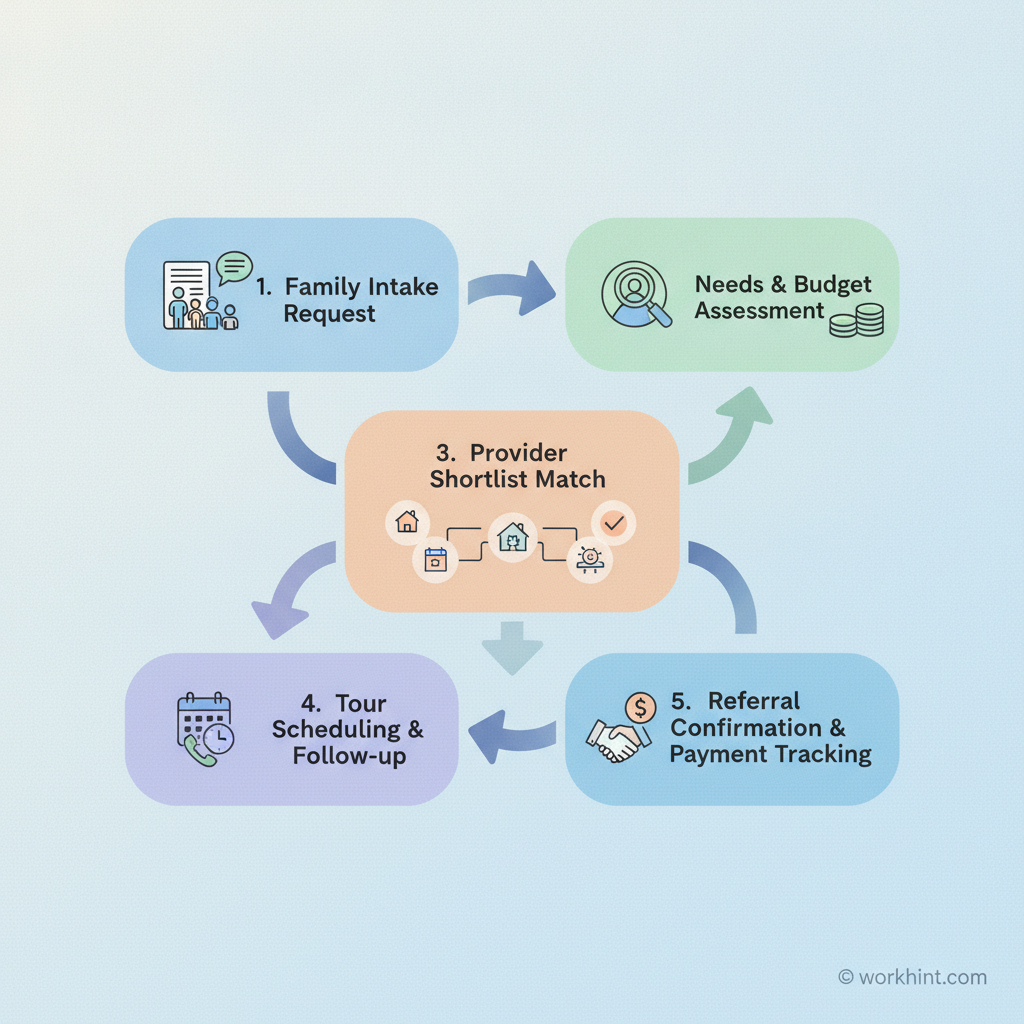
Inside the platform, you can route the inquiry through a structured assessment, match it against your provider network, assign an independent advisor or partner, schedule consultations, collect approvals, track tours, and record follow-up tasks.
When a placement moves forward, Workhint keeps the steps connected: referral agreement, family updates, provider confirmation, fee tracking, payment if needed, partner payout, review request, and reporting. The point is to launch the agency as a working platform from day one.
First 7-day launch plan
Day 1: Choose one launch market, one senior-care decision, and one customer profile. For example, adult children comparing assisted living for a parent within 20 miles.
Day 2: Set up the branded Workhint platform basics: family intake, provider records, advisor roles, contact forms, and status stages.
Day 3: Create the referral process, disclosure language, provider checklist, consultation workflow, tour scheduling flow, and referral-fee tracking.
Day 4: Build the first provider list. Contact local communities, home care providers, elder law firms, move managers, and senior service partners.
Day 5: Start local outreach. Send useful notes to referral sources, post a local guide, and ask for conversations with people who already advise families.
Day 6: Route every inquiry through the platform. Test the intake, matching, tour, follow-up, and provider update process.
Day 7: Review demand, provider responsiveness, pricing, disclosure, and fulfillment quality before spending on ads or staff.
Final launch checklist
- Choose a focused local senior placement niche.
- Register the business and review local legal requirements.
- Define disclosure, referral-fee, privacy, and provider-screening rules.
- Create the branded Workhint customer intake and operations platform.
- Build a starting database of senior living and care providers.
- Recruit independent advisors or trusted resource partners only when demand supports it.
- Create pricing, referral agreements, tour scheduling, follow-up, and payment workflows.
- Launch local outreach through trust-based referral sources.
- Validate demand before hiring employees, renting office space, or buying expensive tools.
FAQ
How much does it cost to start a senior placement agency?
A lean launch can often start with a few thousand dollars for business setup, legal review, insurance, a branded platform, local website, and relationship-building.
Do I need a license to start a senior placement agency?
Rules vary by state and by service type. Check business registration, referral, privacy, healthcare, and senior-care regulations before accepting clients or referral fees.
Can I start a senior placement agency with no staff?
Yes, if you begin with one market, a clear intake process, and provider relationships. Add staff only when inquiry volume justifies it.
How do senior placement agencies make money?
Many earn provider-paid placement or referral fees after a successful move-in. Others charge families for consulting or concierge search support.
How do I find senior living providers to partner with?
Research local communities, visit them, ask about availability and referral policies, and document what each provider serves best.
What is the hardest part of this business?
Trust. Families are making sensitive decisions, and providers need qualified referrals. Your process must be clear, responsive, documented, and honest.
Conclusion
A senior placement agency can start lean when you treat it as a trusted local matching platform, not a traditional office-heavy agency. Pick one market, build provider relationships, create a clear intake and recommendation process, and validate demand before hiring staff.
Workhint gives you the branded foundation to run that process from the first family request through provider matching, scheduling, follow-up, payment tracking, and reporting.
Leave a Reply