


A strong BRD turns scattered stakeholder requests into clear scope, owned requirements, and decisions your team can actually execute.
A business requirements document template helps a team define what a project must achieve before people start building, buying, or changing systems. It gives stakeholders one place to agree on the business goal, scope, requirements, constraints, owners, approvals, and open questions.
The value is alignment. A good BRD prevents teams from treating half-formed requests as approved work, keeps scope changes visible, and gives project owners a practical reference when priorities shift.
What is included in this business requirements document template?
This resource is designed for business projects, operations changes, internal tools, vendor implementations, and workflow redesigns. It works whether the final solution is software, a process, a vendor service, or a new operating model.
- Business goal: the outcome to improve.
- Stakeholders: decision makers, users, reviewers, approvers, and impacted teams.
- Scope: what is included, excluded, and dependent on other work.
- Current state: the existing process, pain points, tools, and handoffs.
- Future state: the required process, capabilities, controls, and user experience.
- Requirements: business, functional, non-functional, reporting, compliance, and integration needs.
- Acceptance criteria: how each requirement is verified.
- Approvals and change control: who signs off and how changes are reviewed.
Atlassian describes a BRD as a way to outline project needs and expectations so stakeholders can communicate clearly. The practical test is simple: can someone use the document to make better decisions about what should happen next?
How to use the template before work starts
- Start with the business problem. Do not begin with features. Write the operational, financial, customer, risk, or compliance problem the project is supposed to solve.
- Identify real stakeholders. Include people who approve, fund, use, support, report on, or are affected by the work.
- Separate needs from solutions. A requirement should describe what the business needs to happen. The solution may be a workflow, automation, vendor tool, policy, or system change.
- Make every requirement testable. Replace vague phrases like “easy to use” with acceptance criteria, examples, data fields, service levels, or review steps.
- Record assumptions and open questions. Hidden assumptions create rework. Put them in the document and assign owners.
- Define approval and change rules. A BRD without change control becomes outdated the first time a stakeholder changes their mind.
The IIBA guidance on elicitation preparation highlights the need to review existing documents, business rules, policies, regulations, and contracts before stakeholder conversations. That is a useful reminder: a BRD should be based on evidence, not only meeting notes.
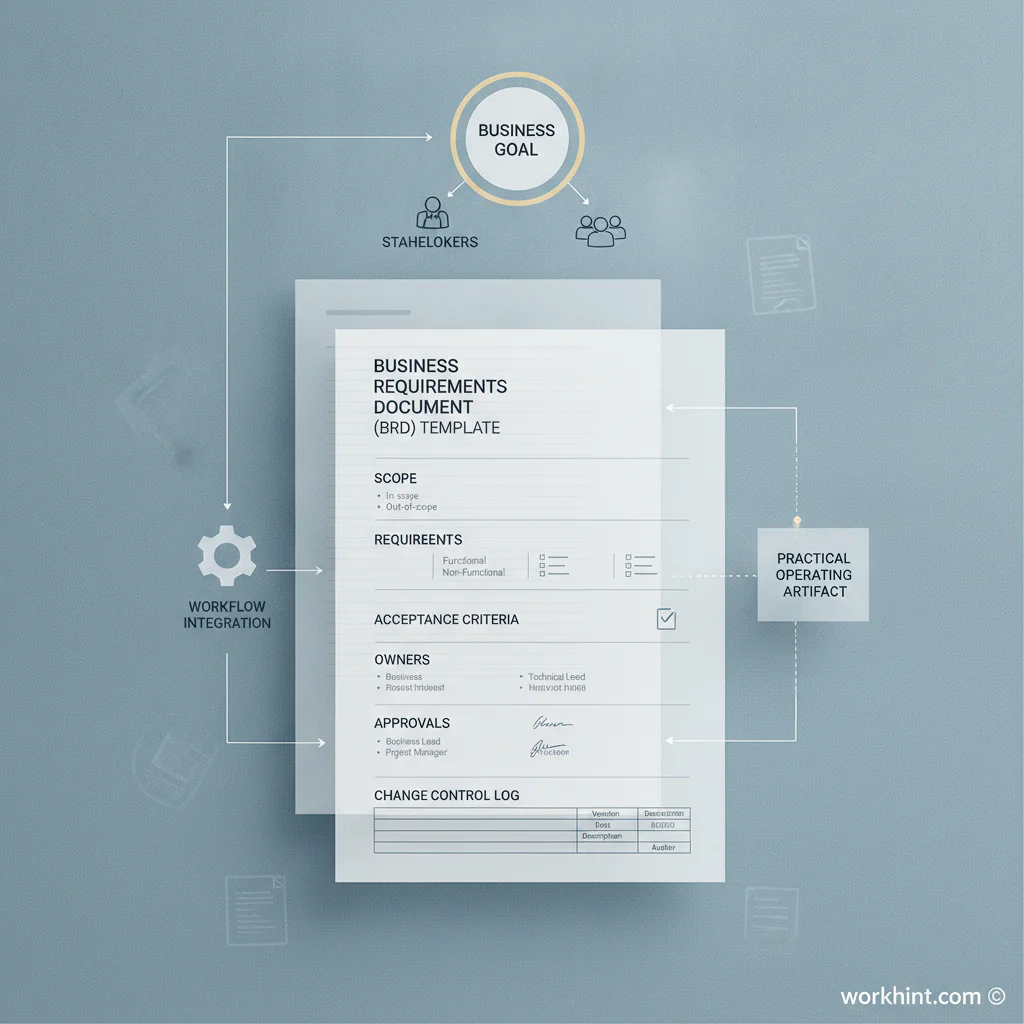
Copy-ready business requirements document template
| Section | What to capture | Questions to answer | Owner |
|---|---|---|---|
| Executive summary | Project purpose, business outcome, sponsor, target users, and expected decision. | Why does this project matter now? What outcome should improve? | Project sponsor |
| Business problem | Current pain, risk, cost, delay, customer issue, compliance gap, or operational bottleneck. | What is broken, slow, expensive, risky, or inconsistent today? | Business owner |
| Stakeholders | Approvers, users, operators, support teams, finance, legal, compliance, vendors, and customers. | Who decides, who uses it, who supports it, and who is affected? | Project lead |
| Scope | In-scope work, out-of-scope work, dependencies, constraints, and assumptions. | What will this project include, exclude, and depend on? | Project lead |
| Current process | Existing workflow, tools, handoffs, data sources, approvals, documents, and failure points. | How does the work happen today, and where does it fail? | Operations owner |
| Future requirements | Business requirements, functional needs, reporting, permissions, integrations, and controls. | What must be true for the future process to work? | Business analyst |
| Acceptance criteria | Observable proof that each requirement has been met. | How will reviewers verify completion? | Reviewer or QA owner |
| Approval and change control | Sign-off owners, review cadence, change request process, and decision log. | Who can approve the BRD, and how will changes be handled? | Sponsor |
Example: BRD for a contractor onboarding workflow
Business goal: Reduce contractor onboarding delays while keeping document collection, approval, access, and payment setup consistent.
Current problem: Hiring managers collect documents through email, finance receives payment details late, legal approvals are inconsistent, and operations has no reliable status view for blocked contractors.
Future requirements: The workflow must collect required documents, route approval to legal when contract terms change, assign system access only after approval, notify finance when payment setup is ready, and show each contractor’s status by stage.
Acceptance criteria: A contractor cannot move to active status until documents, approvals, access, and payment setup are complete. Managers can see blocked items without asking operations for updates. Finance receives complete payment information before the first approved invoice.
This example works because it does not jump straight to software features. It defines the business outcome, the broken current state, the required future state, and the evidence needed to confirm the process is working.
Common BRD mistakes to avoid
- Writing feature requests instead of business requirements. “Add a dashboard” is a possible solution. “Managers need to see onboarding stage, missing documents, and approval blockers” is a requirement.
- Leaving out out-of-scope work. Scope exclusions prevent stakeholders from assuming the project includes every related problem.
- Skipping non-functional needs. Permissions, security, uptime, audit trail, reporting, data retention, accessibility, and performance often matter as much as visible features.
- Using unclear priority labels. If everything is “high priority,” nothing is. Define must-have, should-have, could-have, and later requirements.
- Approving once and forgetting it. Requirements change. The BRD needs version history, review dates, and a decision log.
PMI’s requirements management resources frame requirements work as a discipline that supports better project outcomes. Smartsheet’s BRD templates also show how broad the document can become, covering scope, business drivers, current process, proposed process, functional requirements, non-functional requirements, assumptions, and references. The key is to include what helps decision-making, not to create paperwork for its own sake.
Where Workhint fits
A BRD is often created as a document, but the work it describes usually needs to become a live operating system. Workhint can help teams turn the requirements into roles, intake steps, permissions, assignments, approvals, documents, schedules, status tracking, reporting, and automation.
For example, a team can use the BRD to define the contractor onboarding workflow, then build the actual process around those requirements: who submits the request, which documents are required, when legal reviews the contract, how access is granted, how payment setup is confirmed, and which dashboard shows blocked work. That keeps the BRD connected to execution instead of leaving it as a static file.
FAQ
Who should write a business requirements document?
The project lead, business analyst, or operations owner usually drafts it, but the content should come from stakeholders who understand the business problem, current process, constraints, users, and approvals.
What is the difference between a BRD and a PRD?
A BRD defines the business need and expected outcome. A product requirements document usually translates that need into product behavior, user stories, feature requirements, and delivery details.
How detailed should a BRD be?
Detailed enough that stakeholders can approve the scope and delivery teams can understand what must be true. Avoid excessive detail that belongs in technical specifications, implementation tickets, or vendor contracts.
Should every project have a BRD?
No. Small, low-risk work may only need a short brief. Use a BRD when the work has multiple stakeholders, material cost, compliance risk, operational complexity, external vendors, or meaningful change impact.
When should a BRD be updated?
Update it when scope, assumptions, requirements, owners, approvals, timelines, or acceptance criteria change. Keep a version history so stakeholders can see what changed and why.
Conclusion
A business requirements document template gives teams a practical way to turn needs, decisions, constraints, and stakeholder input into clear project direction. The strongest BRDs are not long for the sake of being long. They are specific, testable, owned, and connected to the work that follows.
Use the template above to align the business before delivery begins, then keep it alive as scope, decisions, and operating realities change.
Leave a Reply