


Partner programs break when ownership, approvals, and performance reviews live in different places.
Channel partner management is the operating process a company uses to coordinate resellers, referral partners, implementation partners, agencies, affiliates, distributors, and other outside organizations that help sell, deliver, or support its work. It decides which partners matter, what each partner may do, who owns the relationship, how work is routed, and how performance is reviewed.
Companies usually do not fail because they picked the wrong portal. They fail because partner work becomes informal. A partner asks for a lead exception in email. Finance waits for payment details. Legal cannot find the agreement. No one knows whether the partner is active, stuck, or creating channel conflict.
What’s in this article?
- What channel partner management includes after onboarding.
- The operating workflow for managing partner activity.
- KPIs that show whether partners are healthy or stuck.
- Common partner management mistakes that create conflict.
- Where Workhint fits when partner operations need structure.
Why channel partner management matters
Partner programs add leverage, but they also add moving parts outside the company. Partners may represent multiple vendors, share customers, submit opportunities, need training, require approvals, or deliver work under your brand. Gartner describes partner relationship management applications as tools that help organizations interact with indirect partners, improve partner experience, streamline deal registration, and reduce channel conflict. The operating lesson is simple: when partners become part of revenue or delivery, the business needs more than ad hoc account notes.
A good partner management process creates a reliable record of partner status, scope, owners, permissions, commitments, activity, and results. Sales knows how deals are registered. Operations knows how partner-delivered work is assigned. Finance knows when commissions, invoices, or payouts are ready. Leadership can see which partnerships deserve more support and which should be paused.
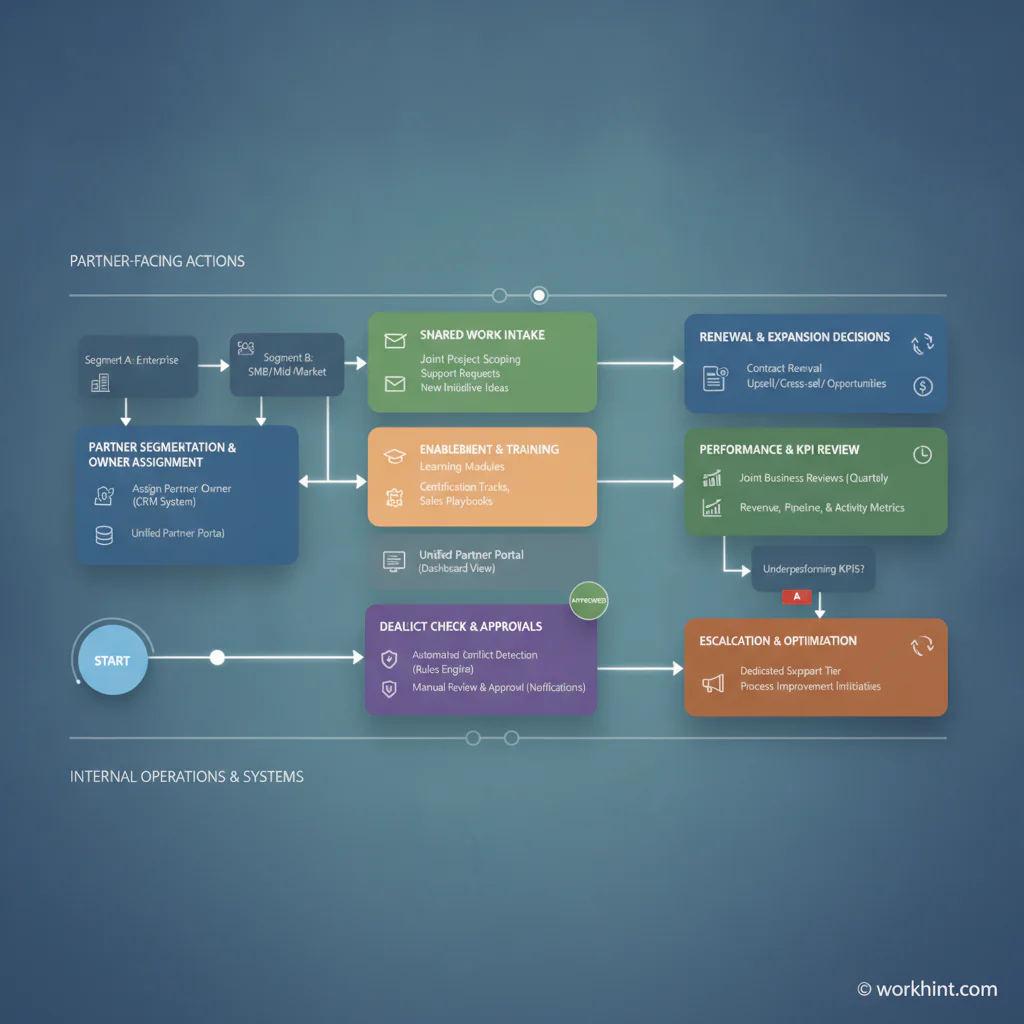
Channel partner management workflow
The workflow should begin after partner fit and onboarding are complete. Onboarding answers whether a partner is ready to work with you. Channel partner management answers how the relationship will run week after week.
- Segment the partner. Label the partner type, tier, market, service line, territory, customer segment, and permitted activities.
- Assign an internal owner. Every active partner needs one accountable owner and clear backup coverage.
- Define the operating rules. Capture deal registration rules, approval thresholds, territory rules, handoff steps, support paths, and payment or incentive terms.
- Centralize shared work intake. Route partner requests, customer opportunities, co-marketing asks, enablement needs, implementation tasks, and exceptions through one workflow.
- Check conflicts before action. Review overlap with existing accounts, territories, vendors, service partners, or contractual restrictions before work proceeds.
- Track execution evidence. Store notes, assets, customer handoffs, task completion, training status, approvals, documents, and outcome data against the partner record.
- Review performance on a cadence. Use weekly operational checks for active work and monthly or quarterly reviews for strategy, investment, and renewal decisions.
Channel partner KPIs to track
Do not measure every possible activity. Choose a short scorecard that matches the partner model. A referral partner should not be judged like an implementation partner. A reseller should not be judged only on meeting attendance. The Channel Institute emphasizes structured channel management best practices, and the same discipline applies to measurement: define the behavior and outcome you expect before asking for reports.
| KPI | What it tells you | Best for |
|---|---|---|
| Active partner rate | Whether onboarded partners are actually doing useful work. | All partner programs |
| Registered opportunities | Whether partners are creating qualified commercial activity. | Referral, reseller, channel sales |
| Acceptance or approval time | Whether internal reviews are slowing partner momentum. | Deal registration, vendor-like partners, implementation partners |
| Partner-sourced revenue or delivery volume | Whether the partnership is producing business outcomes. | Sales, marketplace, agency, delivery partnerships |
| Escalation rate | Whether the relationship has unresolved conflict, quality, or support issues. | Strategic partners and service partners |
| Renewal or expansion readiness | Whether the partner should receive more scope, less scope, or a new agreement. | Long-term partner programs |
Build the operating cadence
Partner management works best when it has a rhythm. Partnership Leaders has written about scaling partner operations and programs, and the practical takeaway is that partner success depends on repeatable operations, not heroic relationship management. Set a cadence that matches the partner tier.
For strategic partners, run a monthly operating review and a quarterly business review. For smaller referral or affiliate partners, a lighter monthly status review may be enough. Each review should answer four questions: what changed, what is stuck, what needs approval, and what decision should we make next?
The cadence should produce action, not slides. If a partner needs enablement, assign it. If a deal is blocked by territory conflict, route the decision. If a service partner is missing quality targets, open a corrective action plan. If a partner has earned more scope, document the expansion path.
Common mistakes in partner management
- Treating onboarding as the finish line. The real work begins after the partner has access, materials, and a first motion.
- Using revenue as the only signal. Revenue matters, but early indicators such as activation, response time, deal quality, and training completion show problems sooner.
- Letting every team manage partners differently. Inconsistent rules create channel conflict and make partner performance impossible to compare.
- Failing to define decision rights. Partners need to know who can approve discounts, exceptions, territory overlaps, co-marketing spend, customer handoffs, and delivery changes.
- Keeping partner records in scattered tools. A CRM may hold account notes, but operations also need documents, approvals, permissions, tasks, payments, and reporting.
Where Workhint fits
Workhint fits when channel partner management needs to become a working system instead of a loose set of spreadsheets, shared folders, CRM notes, and message threads. A business can use Workhint to map partner types, assign owners, collect partner information, route approvals, manage shared tasks, control access, track enablement, coordinate handoffs, monitor payment or incentive status, and report on partner activity from one operational flow.
The point is not to replace every sales or finance system. The point is to connect the work around the partner relationship. When a partner submits a request, Workhint can route it to the right owner. When a deal needs approval, the decision can be recorded. When a partner moves tiers, the required documents, permissions, tasks, and reporting can change with it.
FAQ
What is channel partner management?
Channel partner management is the process of recruiting, enabling, coordinating, supporting, measuring, and improving relationships with outside partners that sell, refer, deliver, or support a company’s products and services.
What is the difference between partner onboarding and partner management?
Partner onboarding prepares a partner to start working with the business. Partner management governs the ongoing relationship after onboarding, including activity, approvals, performance, communication, incentives, support, and renewals.
Who should own channel partner management?
Ownership depends on the partner model. Sales may own reseller or referral partners, operations may own delivery partners, and customer success may own implementation partners. The important rule is that each active partner has one accountable internal owner.
What software is needed for partner management?
Many companies use CRM and PRM tools for partner records, enablement, and deal registration. They also need an operating workflow for approvals, tasks, documents, access, payments, and reporting. That is where a work-system platform can help.
Conclusion
Channel partner management should make partner work easier to trust. The process should show who owns the relationship, what the partner may do, what work is active, which approvals are pending, how performance is trending, and what decision comes next. When those pieces are visible, partners get better support and the business gets fewer surprises.
Start with a simple partner workflow: segment partners, assign owners, define rules, centralize requests, track evidence, review KPIs, and decide whether to expand, fix, or pause the relationship. That is enough structure to turn partner activity into scalable workforce operations instead of another informal channel to manage by memory.
Leave a Reply