


Recurring problems are rarely solved by another status meeting; they need a system that finds and removes the cause.
A root cause analysis process helps teams understand why an operational problem happened, what conditions allowed it, and what should change so it does not keep happening. The point is not to blame a person or write a long report. The point is to turn a problem into a repeatable improvement cycle.
ASQ defines root cause analysis as a group of approaches, tools, and techniques used to uncover causes of problems. For operations teams, that definition matters because most recurring issues are not isolated events. A late handoff, missed approval, duplicate request, customer complaint, production defect, or payment delay usually points to a weakness in the work system.
What’s in this article?
- When to run root cause analysis instead of a quick fix
- The root cause analysis process teams can use repeatedly
- How to combine 5 Whys, fishbone diagrams, evidence, and corrective actions
- How to make RCA measurable instead of performative
Why root cause analysis matters
Most teams are busy enough that they solve the same problem many times. Someone manually pushes a request forward. A manager reminds the approver. A team lead explains the same workaround again. The immediate issue clears, but the operating system does not improve.
Root cause analysis creates a pause between the symptom and the fix. Harvard Business School Online notes that RCA starts by identifying the most important performance or opportunity gaps facing a team. That is the right starting point: do not investigate every annoyance with equal weight. Use RCA when the issue is recurring, costly, risky, customer-visible, compliance-sensitive, or blocking important work.
Root cause analysis process workflow
A useful RCA process has seven steps. The order matters because teams often jump from problem to solution before they have enough evidence.
- Define the problem clearly. Write the problem as an observable gap: what happened, where it happened, when it happened, who was affected, and what expected outcome failed.
- Decide whether RCA is warranted. Set trigger criteria, such as repeated occurrence, financial impact, customer impact, SLA breach, safety or compliance risk, or cross-functional confusion.
- Gather evidence. Collect timestamps, request records, system logs, messages, handoff notes, approvals, screenshots, customer feedback, and process documentation. Avoid relying only on memory.
- Map the sequence. Build a short timeline from trigger to outcome. Identify where the process waited, forked, lost context, or required manual intervention.
- Analyze causes. Use 5 Whys for a simple cause chain and a fishbone diagram when multiple categories may contribute. CMS describes the fishbone diagram as a structured way to brainstorm possible causes and sort them into useful categories.
- Choose corrective actions. Fix the work system, not just the incident. Actions may include changing intake fields, routing rules, ownership, training, permissions, templates, quality checks, escalation paths, or dashboards.
- Verify and monitor. Assign owners, due dates, and evidence requirements. Then measure whether recurrence drops, cycle time improves, or the control actually works.
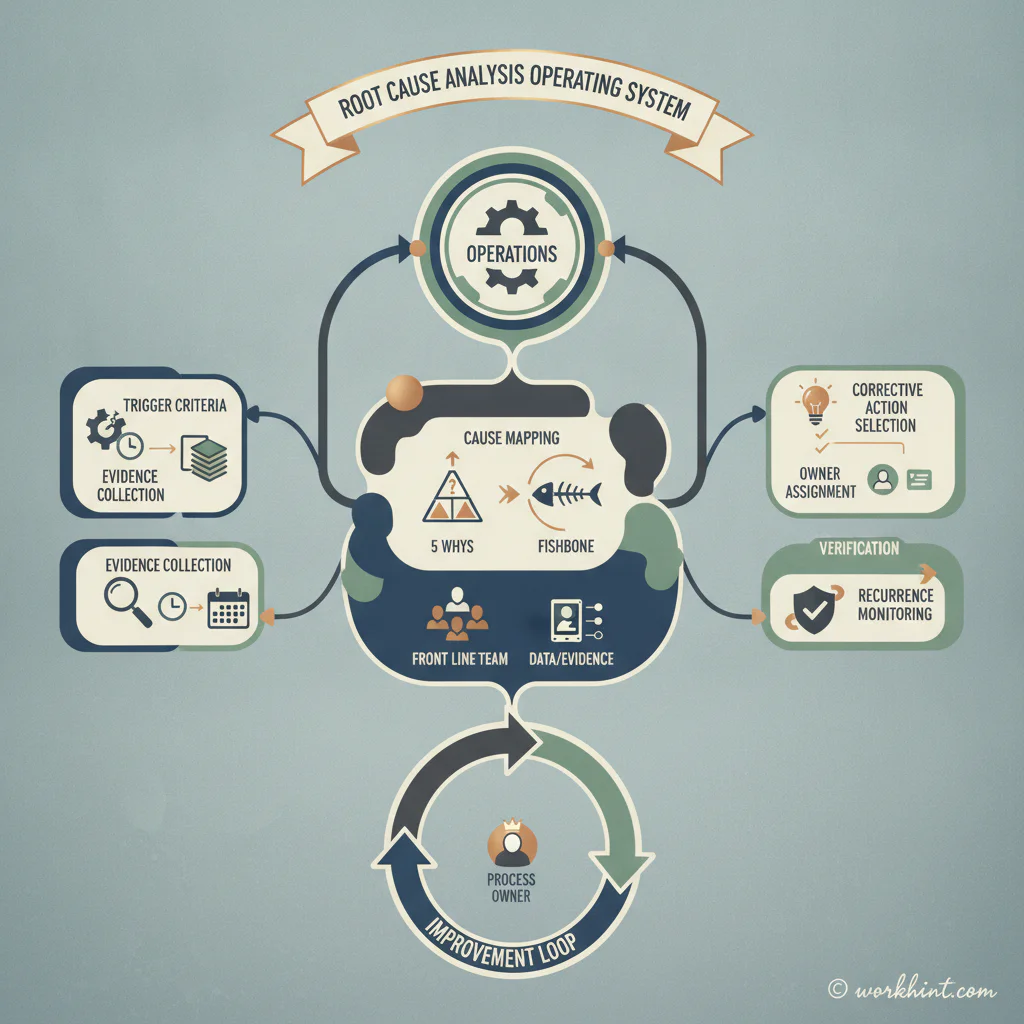
Root cause analysis table for operations teams
| RCA stage | Question to answer | Output | Owner |
|---|---|---|---|
| Problem definition | What failed and what should have happened? | Problem statement | Process owner |
| Evidence review | What facts prove the sequence of events? | Timeline and evidence pack | Operations lead |
| Cause analysis | Which system conditions allowed the problem? | Cause map | Cross-functional team |
| Corrective action | What change prevents recurrence? | Action plan | Named action owners |
| Verification | How will we know the fix worked? | Metric, review date, and proof | Process owner |
How to avoid shallow RCA
The most common RCA failure is stopping at the first plausible explanation. “The approver missed the request” may be true, but it is usually not the root cause. The deeper questions are: why was the request easy to miss, why was there no backup approver, why did the requester lack status visibility, and why did the process depend on manual follow-up?
Use 5 Whys carefully. It is useful for drilling past symptoms, but it can become too linear when a problem has multiple contributing factors. For complex issues, pair it with a fishbone diagram covering people, process, systems, policy, data, environment, and customer inputs. Then test each cause against evidence.
Turn findings into corrective actions
A root cause analysis process is only as good as the action plan that follows it. The Joint Commission’s RCA and action plan framework emphasizes connecting findings to corrective actions. In business operations, that means every action should name what will change, who owns it, when it is due, what proof is required, and which metric will confirm improvement.
Weak action: “Train the team.” Stronger action: “Update the vendor intake form to require budget owner, approver, risk tier, and target start date before submission; route incomplete requests back to requester automatically; review rejected submissions weekly for 30 days.”
Where Workhint fits
Workhint helps teams turn RCA from a document into a live work system. A team can structure the RCA intake, assign process owners, route evidence collection, create review steps, trigger corrective actions, set escalation paths, and monitor recurrence in one connected workflow. That matters when RCA touches operations, finance, customer success, compliance, IT, or external partners.
The practical value is continuity. The problem statement, timeline, cause map, decisions, owners, due dates, documents, dashboards, and follow-up checks stay connected instead of scattering across meetings, spreadsheets, and chat threads.
FAQ
What is a root cause analysis process?
A root cause analysis process is a structured way to investigate a problem, identify the underlying causes, choose corrective actions, and verify that the problem is less likely to recur.
When should a business run RCA?
Run RCA when an issue repeats, creates material cost, affects customers, creates compliance risk, blocks delivery, or reveals a breakdown across teams, systems, or handoffs.
Is 5 Whys enough for root cause analysis?
Sometimes. 5 Whys can work for simple cause chains, but complex operational problems often need a timeline, evidence review, fishbone diagram, and cross-functional discussion.
Who should own RCA?
The process owner should own the RCA outcome. Operations can facilitate the analysis, but the person accountable for the end-to-end process should own corrective action and verification.
Conclusion
Root cause analysis is not just a problem-solving technique. It is a work system for learning from operational failure. Define the problem, gather evidence, map the sequence, test causes, assign corrective actions, and verify that the fix works. When teams run that process consistently, recurring problems become inputs for better workflows, clearer ownership, stronger controls, and measurable improvement.
Leave a Reply