


You can validate an answering service before hiring receptionists by launching the platform, scripts, and provider network first.
How to start an answering service is no longer just a question about phone lines and office staff. A modern version can start as a branded platform that routes calls, captures messages, books appointments, and coordinates independent receptionists only when demand justifies it.
The opportunity is simple: small businesses miss calls, after-hours requests, appointment inquiries, and urgent customer messages because they cannot justify full-time coverage. An answering service gives them a professional front desk without another payroll line.
The low-risk path is to validate demand before building a traditional call center. Start with one niche, a clear offer, a branded customer portal, call handling rules, and a small bench of trained independent providers. Workhint can become the operating foundation behind that model.
What’s in this article?
- Why an answering service business works
- What you need before taking the first client
- How to price monthly and per-minute plans
- How to get the first customers
- How Workhint helps launch the business
- A 7-day launch plan, checklist, and FAQ
Why this business works
An answering service solves a direct revenue problem. Local service companies, law firms, clinics, real estate offices, consultants, and contractors often lose leads when calls go unanswered. They do not always need a full call center. They need reliable coverage, clear escalation rules, and fast message delivery.
The business also has recurring revenue potential. Clients usually pay monthly because phone coverage is ongoing. You can start with a narrow offer such as after-hours answering for home service companies, intake calls for solo law firms, or appointment requests for wellness providers.
Providers join because the work can be remote, structured, and shift-based. Customers buy because the alternative is missed revenue, overloaded staff, or expensive in-house reception.
What you need to launch
You do not need an office, a large team, or a custom phone system to test the market. You need a professional operating setup that makes one client feel handled from day one.
| Typical early budget item | Lean launch estimate | Why it matters |
|---|---|---|
| Business registration | $100 to $800 | Creates the legal entity and business bank setup. |
| Insurance and legal review | $500 to $2,500 | Protects against call handling mistakes and client disputes. |
| Branded Workhint platform | Start lean | Runs intake, client onboarding, provider routing, scripts, approvals, and reporting. |
| VoIP or business phone tools | $30 to $300 per month | Handles client numbers, routing, call forwarding, and basic reporting. |
| Headsets and work setup | $100 to $500 | Only needed for the first operator or provider bench. |
| Initial marketing | $200 to $1,000 | Funds a niche landing page, local outreach, and simple sales materials. |
For regulated niches, especially healthcare, get legal guidance before handling protected information. For most first tests, choose lower-compliance niches such as home services, local contractors, appointment-based studios, or independent professionals.
How to price it
Start with simple plans. Small businesses want predictable coverage, not a complicated telecom contract. Price around the problem you solve: missed calls, booking requests, urgent messages, and after-hours coverage.
| Plan | Example price | Best fit |
|---|---|---|
| Starter overflow | $149 to $299 per month | Low call volume businesses that need backup coverage. |
| After-hours coverage | $299 to $599 per month | Contractors, clinics, and service firms that miss evening calls. |
| Appointment intake | $500 to $1,200 per month | Businesses that need calls answered, qualified, and booked. |
| Per-minute usage | $1 to $3 per handled minute | Clients with variable call volume. |
Keep the first offer narrow. A strong first package might include live answer scripts, message capture, emergency escalation, appointment request intake, and a weekly call summary. Add bilingual coverage, scheduling, or CRM updates after you prove demand.
How to get first customers
Start with businesses where missed calls are obviously expensive. HVAC companies, plumbers, law firms, dental offices, med spas, property managers, and real estate teams all care about speed to response.
Use direct outreach with a specific problem: missed calls after 5 p.m., weekend appointment requests, emergency routing, or overflow during busy seasons. Offer to set up a simple call handling test for one week before asking for a long contract.
Partnerships also work. Web agencies, local marketing consultants, trade associations, business coaches, and phone system installers often know companies that need better call coverage but do not want to hire staff.
How Workhint helps launch it
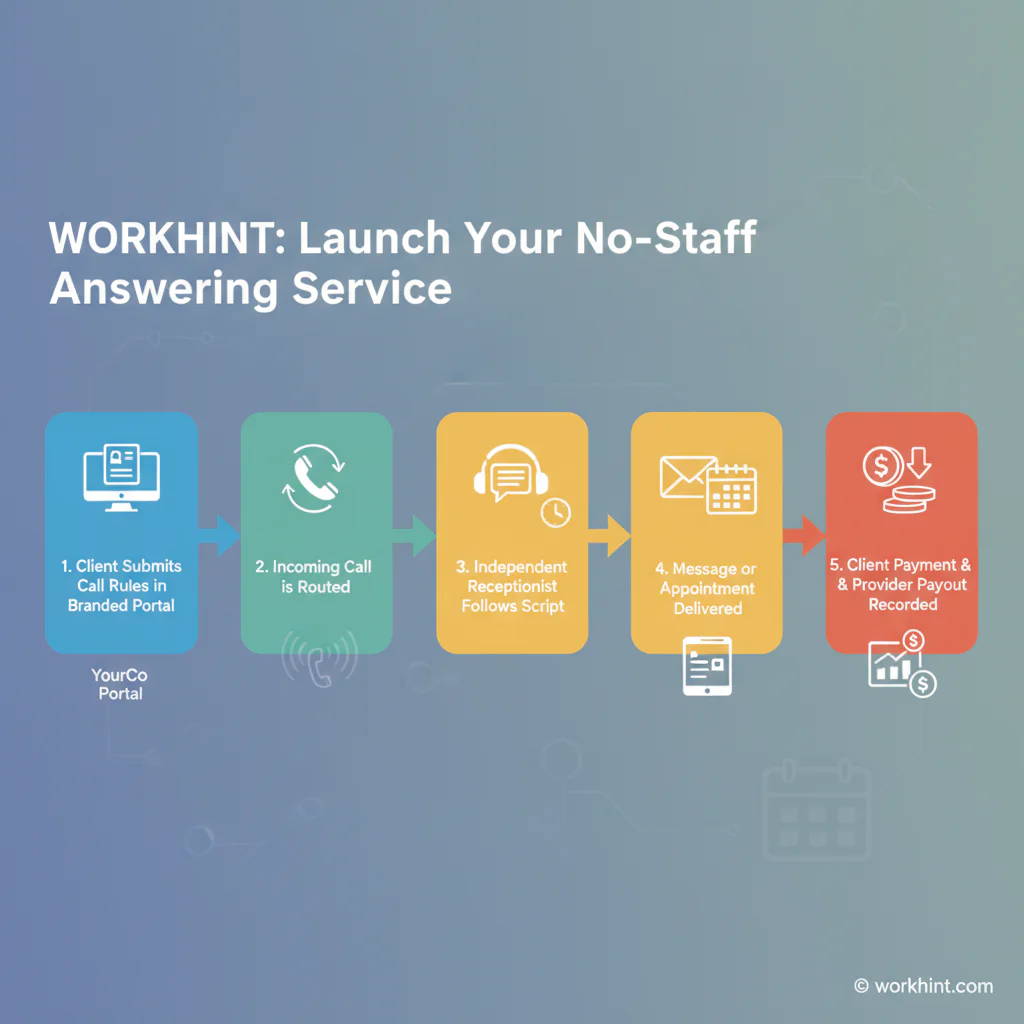
Workhint lets you create the branded operating platform for the answering service before you build a traditional call center. A client can sign up through your branded portal, choose coverage rules, submit scripts, add escalation contacts, define urgent call criteria, and approve the first service plan.
Behind the scenes, Workhint can organize provider onboarding, shift availability, client-specific scripts, call outcomes, message approvals, scheduling requests, quality checks, invoices, online payments, and provider payouts. The business owner sees one operating system instead of separate forms, spreadsheets, phones, calendars, payment tools, and contractor messages.
The platform-first model matters because you can sell the service before overinvesting. If five contractors in one city want after-hours coverage, you can configure their flows, train two independent receptionists, route the calls, review outcomes, invoice clients, and pay providers from the same foundation.
First 7-day launch plan
- Day 1: Pick one niche, one city or market, and one clear problem such as after-hours calls for home service companies.
- Day 2: Set up the branded Workhint platform basics, including client intake, scripts, escalation contacts, and service packages.
- Day 3: Create the call handling process, message templates, quote approval flow, billing rules, and provider payout process.
- Day 4: Recruit two to five independent receptionists or experienced virtual assistants for pilot coverage.
- Day 5: Contact 30 to 50 local prospects with a specific missed-call or after-hours offer.
- Day 6: Book pilot calls, route test requests through the platform, and confirm the provider workflow works.
- Day 7: Review demand, pricing, call quality, provider readiness, and whether to keep selling before adding more tools.
The goal is not to look large. The goal is to prove that a real customer will pay for structured call coverage, then improve the operation with evidence.
Final launch checklist
- Choose a focused answering service niche.
- Register the business and open a separate bank account.
- Confirm insurance and compliance needs for the target market.
- Create the branded Workhint customer portal and intake flow.
- Define call scripts, escalation rules, and message delivery standards.
- Recruit the first independent receptionists or virtual assistants.
- Set pricing, billing, and provider payout rules.
- Sell one pilot offer before hiring employees or leasing office space.
FAQ
How much does it cost to start an answering service?
A lean answering service can often start with a few thousand dollars for registration, insurance, phone tools, branding, and initial marketing. Avoid office space and employee payroll until demand is proven.
Can I start an answering service with no staff?
Yes, if you start with a narrow offer, handle early calls yourself, or coordinate independent receptionists for pilot coverage. The article’s no-staff model means no full-time employees at launch, not no human coverage.
Do I need special licenses?
Most answering services need standard business registration, but requirements vary by location and niche. Healthcare, legal, and financial clients may require stricter privacy, documentation, and contractual protections.
What businesses use answering services?
Common buyers include home service companies, law firms, medical offices, real estate teams, property managers, consultants, salons, clinics, and any business where missed calls create lost revenue.
How should I price an answering service?
Use monthly packages for predictable coverage and per-minute fees for variable usage. Early plans can range from low-cost overflow coverage to higher-priced appointment intake and after-hours support.
What should I avoid at the start?
Avoid leasing an office, hiring a full team, buying heavy phone infrastructure, or promising 24/7 coverage before you have enough providers and process control to deliver reliably.
Conclusion
An answering service is a strong Startup category business because the pain is clear, the revenue can recur, and the first version can be tested without a traditional office or employee-heavy model. Start with one niche, one simple offer, a small provider bench, and a branded Workhint platform that turns calls into an organized service operation.
Leave a Reply