


Internal SLAs turn vague team promises into measurable service commitments people can actually run.
An internal SLA is a service level agreement between teams inside the same company. It defines what one team provides, how requests enter the workflow, response and resolution expectations, ownership, and measurement.
The point is not to create another policy document. The point is to make internal work predictable. When service teams support the rest of the business, unclear expectations quickly turn into urgent messages, missed handoffs, and arguments about priority.
What’s in this article?
- What an internal SLA should include.
- How to choose realistic response and resolution targets.
- A step-by-step workflow for building one.
- Where Workhint fits when the SLA needs to become a live workflow.
Why internal SLAs matter
Internal services often fail quietly before they fail visibly. A request sits in email because no one knows whether it is urgent. A finance approval waits because documents were incomplete. A legal review gets escalated because the requester expected a same-day answer, while legal assumed five business days.
Atlassian describes SLAs as commitments around response and resolution times that set expectations and help measure service performance. For internal teams, the same principle applies, but the agreement must also describe request quality, requester responsibilities, ownership, escalation, and capacity constraints.
How to create an internal SLA
Start with one recurring service. Do not write one agreement for every department. Choose a workflow with enough volume or friction, such as employee onboarding, vendor approvals, contract reviews, invoice exceptions, customer escalations, creative requests, system access, or field support.
- Define the service boundary. Name the service, who can request it, what is included, what is excluded, and what triggers the SLA clock.
- Standardize intake. Decide what information must be submitted before the request can be accepted. The Project Management Institute describes intake as the bridge between business stakeholders and the delivery group; internal SLAs need the same bridge.
- Classify request types. Separate standard work, urgent work, exceptions, high-risk requests, and work that requires approval from another team.
- Set response targets. Define when the receiving team must acknowledge, clarify, accept, reject, or reroute the request.
- Set resolution targets. Define completion targets by request type, priority, complexity, or required approval path.
- Assign owners. Name the accountable service owner, request owner, approver, backup owner, and escalation path.
- Measure and review. Track volume, aging, first response time, resolution time, reopened work, breach reasons, requester satisfaction, and recurring blockers.
Internal SLA template for business teams
Use the table below as a starting point. The exact targets should reflect capacity, risk, and service complexity, not wishful thinking.
| SLA element | What to define | Example |
|---|---|---|
| Service scope | What the team provides and excludes | Legal reviews vendor agreements under $100K; employment matters follow a separate path |
| Intake requirements | Minimum information before work starts | Contract, business owner, vendor name, deadline, risk notes, requested change |
| Priority levels | How work is classified | Standard, urgent, executive escalation, compliance-sensitive |
| First response | When the team acknowledges or asks for missing details | One business day for standard requests |
| Resolution target | When the request should be completed | Three business days after complete intake for standard reviews |
| Requester duties | What the requesting team must do | Submit complete details, answer clarifying questions, avoid side-channel approvals |
| Review cadence | How the SLA is improved | Monthly review of breaches, volume, exceptions, and target realism |
Set targets that teams can keep
The fastest way to ruin an internal SLA is to make every target aggressive. If everything is urgent, the SLA becomes fiction. Start with the normal path, then define exceptions.
Zendesk’s SLA guidance notes that internal SLAs can give individual teams targets inside a larger ticket or service workflow. That distinction matters when one customer or employee commitment depends on support, billing, product, and operations.
Use three levels for workflows. Standard requests follow the normal queue. Time-sensitive requests need a clear business reason. Critical requests should be rare and tied to customer impact, compliance risk, payroll, access outage, or executive-approved priority.
How to run the SLA as a workflow
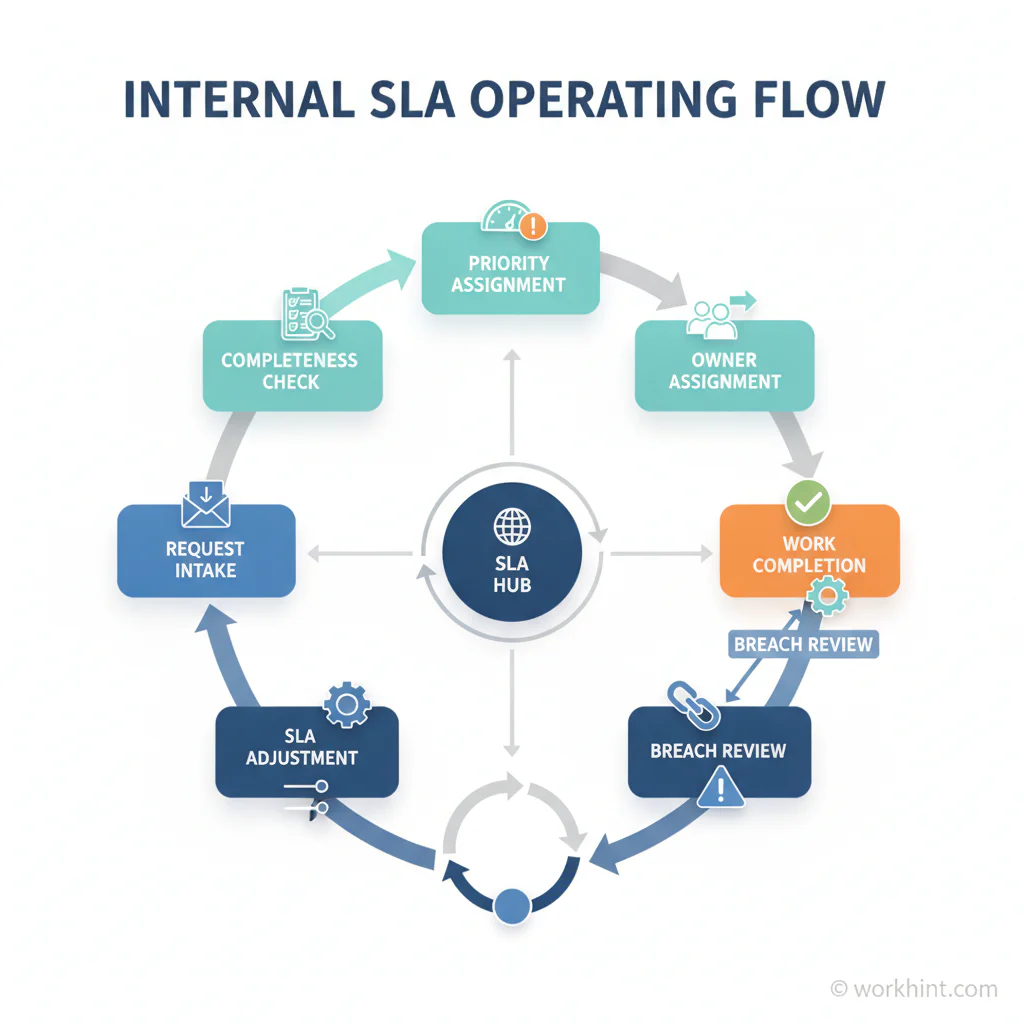
An internal SLA only works if it changes how work moves. Put the SLA into the intake form, routing rules, ownership model, dashboard, and review rhythm.
- Request submitted: The requester selects the service type and provides required details.
- Completeness check: The receiving team accepts, asks for missing information, or reroutes the request.
- Priority assigned: The request is classified by urgency, risk, customer impact, and complexity.
- Owner assigned: One accountable owner takes responsibility for the next action.
- Work completed: The owner completes the service or records why it is blocked.
- Breach reviewed: Missed targets are reviewed for root cause, not blame.
- SLA adjusted: Targets, intake rules, routing, or staffing are changed when the data shows the system is unrealistic.
Public SLA examples show why this operating detail matters. A Johns Hopkins HR/Payroll Shared Services SLA outlines service expectations, shared responsibilities, measurement, and partnership language. That is the right mindset: make cooperation clearer, not adversarial.
Common internal SLA mistakes
The first mistake is measuring only speed. Fast but incomplete work still creates rework. Include quality signals such as reopened requests, missing information, rejected approvals, customer impact, and satisfaction.
The second mistake is ignoring demand. A team cannot meet a two-day target if volume doubles and staffing stays flat. Track backlog and capacity so missed SLAs reveal the constraint.
The third mistake is creating targets without an escalation rule. If a request is blocked by missing information, legal risk, budget approval, vendor delay, or unclear decision rights, the workflow needs a next step. Otherwise the SLA clock becomes a scoreboard for stuck work.
Where Workhint fits
Workhint fits when an internal SLA needs to become a live work system instead of a document. A team can describe the service workflow it wants, then build the intake form, roles, permissions, assignments, approvals, dashboards, automations, escalations, and reporting around that operating model.
That is useful because internal SLAs often cross tools. A request starts in a form, context lives in email, approvals happen in chat, and status sits in a spreadsheet. Workhint helps structure those parts into one system so teams can see what was requested, who owns it, what target applies, and what is blocked.
FAQ
What is an internal SLA?
An internal SLA is an agreement between teams inside the same company that defines service scope, request requirements, response targets, resolution targets, ownership, escalation, and measurement.
How is an internal SLA different from a customer SLA?
A customer SLA defines commitments to an external customer. An internal SLA defines how internal teams support each other so the business can meet employee, customer, operational, or vendor commitments.
What should an internal SLA include?
It should include service scope, intake requirements, request categories, priority levels, first response targets, resolution targets, requester responsibilities, owner responsibilities, escalation rules, reporting, and review cadence.
How often should internal SLAs be reviewed?
Review high-volume or high-risk SLAs monthly at first. Once the workflow is stable, a quarterly review may be enough, as long as breaches, backlog, volume changes, and recurring exceptions are still visible.
Should internal SLAs have penalties?
Most internal SLAs should focus on clarity and improvement rather than penalties. If targets are missed, review whether the cause is incomplete intake, unrealistic demand, unclear ownership, tooling gaps, or capacity limits.
Conclusion
An internal SLA is not just a promise to move faster. It is a work system for recurring service commitments inside the business.
Start with one workflow, define the service boundary, standardize intake, set realistic targets, assign owners, and review the misses. The best internal SLAs make work easier to request, easier to own, easier to measure, and easier to improve. That is what turns internal service from a queue of favors into a scalable operating system.
Leave a Reply