


Contract renewals go wrong when teams treat them like dates instead of decisions.
A contract renewal process is the workflow a business uses to decide whether to renew, renegotiate, replace, or end an agreement with a vendor, contractor, agency, supplier, or partner. The point is to make a better operating decision before the agreement quietly rolls forward.
That matters for any company relying on external teams. A renewal may affect pricing, quality, data access, insurance, security, compliance, payment terms, staffing capacity, and customer delivery. If the renewal owner only checks the expiration date, the business can renew a weak relationship, miss a termination window, or keep access open for a partner that should have been offboarded.
What’s in this article?
- A practical contract renewal timeline.
- The owners and decision gates before renewal.
- A checklist for vendors, contractors, agencies, and external partners.
- Common mistakes that create cost, quality, security, and compliance risk.
- Where Workhint fits when renewal management needs to become a repeatable workflow.
Why the contract renewal process matters
Renewals are operational control points. They are the moment to ask whether the relationship still fits, whether the outside party delivered, whether terms need to change, and whether the business still needs the same scope.
Public-sector procurement shows how early renewal triggers can be. The GSA Vendor Support Center’s option renewal process describes system queries for contracts expiring in the next 250 days. Most companies do not need that exact window, but renewal work should begin far enough ahead to allow review, negotiation, replacement, or offboarding.
Renewals also touch risk. The NIST supply chain risk management guidance emphasizes identifying, assessing, and mitigating risks throughout the supply chain. If a vendor has sensitive access, renewal should include more than price and signature status.
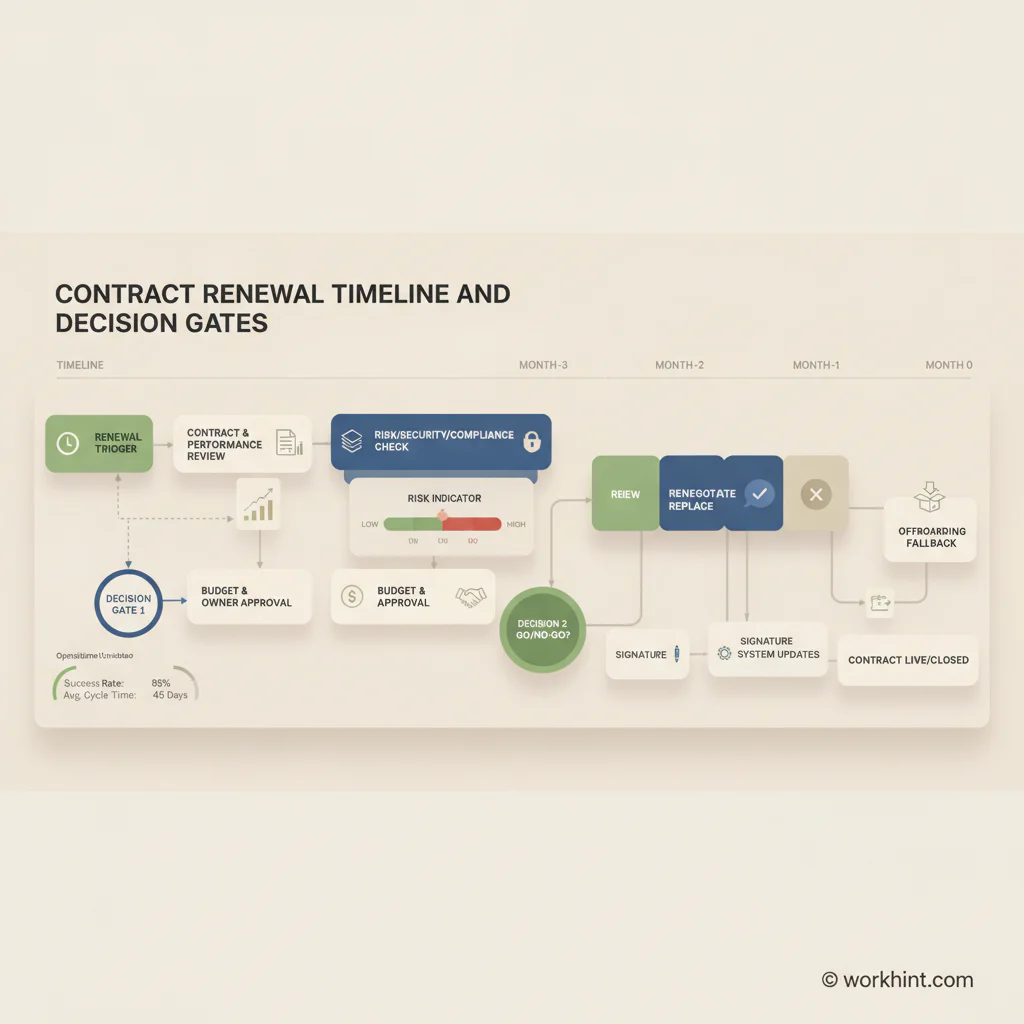
Contract renewal timeline and decision gates
A useful contract renewal process starts before anyone feels rushed. The exact timeline depends on spend, risk, service criticality, and replacement difficulty, but this pattern works for many external workforce relationships.
| Timing | Decision gate | Primary owner | Output |
|---|---|---|---|
| 180 to 120 days before end date | Renewal trigger | Operations or procurement | Confirm end date, notice period, auto-renewal terms, and business owner. |
| 120 to 90 days | Performance and need review | Business owner | Decide whether the work is still needed and whether the partner is performing. |
| 90 to 60 days | Risk, finance, and scope review | Legal, finance, IT, or security | Review access, data, insurance, payment terms, pricing, compliance, and scope. |
| 60 to 30 days | Renew, renegotiate, replace, or end | Executive or budget owner | Approve the path and assign negotiation, transition, or offboarding work. |
| 30 days to start date | Execution and system update | Operations | Sign documents, update records, adjust access, communicate changes, and track next review. |
Step-by-step contract renewal checklist
Use this checklist for vendors, contractors, agencies, staffing partners, consultants, and other external teams. A low-risk renewal should not require the same review as a critical provider with customer data access.
1. Find the renewal trigger and notice terms
Start with the contract record. Confirm the end date, renewal term, auto-renewal language, notice deadline, termination requirements, price escalation clauses, and any minimum commitment.
2. Confirm the business need
Ask whether the work still matters. Has demand changed? Is the partner still supporting the right team, market, customer, or workflow? Could the work be consolidated, automated, brought in-house, or moved elsewhere?
3. Review delivery evidence
Look at actual performance: completed work, missed milestones, SLA history, quality issues, complaints, responsiveness, change requests, invoice disputes, and stakeholder feedback. The goal is to make the renewal decision from evidence instead of memory.
4. Check risk, access, and compliance
Review the vendor’s current access, data exposure, insurance, security documentation, required certifications, subcontractors, and incident history. The FTC Safeguards Rule guidance, for example, explains requirements for covered financial institutions to maintain information security programs that protect customer information.
5. Review commercial terms
Compare pricing, usage, volume, payment terms, renewal increases, service credits, cancellation rights, and minimums against current needs. If the contract no longer fits the operating model, renewal may require a new scope rather than a simple extension.
6. Route the decision
Every renewal should end in one of four decisions: renew as-is, renew with changes, pause pending remediation, or end the relationship. Assign owners for approval, negotiation, documentation, access changes, and stakeholder communication.
7. Update systems after signature
Once the renewal is signed, update the contract record, payment terms, owner, renewal date, access rules, insurance expiration dates, onboarding tasks, reporting cadence, and performance review schedule. If the decision is not to renew, start offboarding before the end date becomes urgent.
Common contract renewal mistakes
The first mistake is relying on calendar reminders without an owner. A reminder can say a contract is expiring, but it cannot decide who reviews performance, who checks access, who approves budget, or who talks to the vendor.
The second mistake is reviewing only price. Cost matters, but renewal decisions also depend on service quality, reliability, risk, compliance, workload, customer impact, and replacement difficulty.
The third mistake is waiting until the notice period is nearly over. Late renewals weaken negotiation and can force teams to accept poor terms because there is no time to replace the provider.
The fourth mistake is forgetting operational cleanup. A renewal may change scope, payment terms, service owners, access levels, or reporting expectations. If those updates do not reach the systems people use every day, the signed renewal becomes detached from the actual work.
Where Workhint fits
Workhint fits when the contract renewal process needs to become a live operating workflow instead of a spreadsheet, shared drive, and calendar alerts. A team can use Workhint to create renewal triggers, assign owners, route risk and budget approvals, collect performance evidence, manage vendor records, track documents, update access tasks, connect renewal decisions to payment status, and report on upcoming renewals.
That is useful when external work involves multiple owners. Operations may own delivery, finance may own payment terms, legal may own contract language, IT may own access, security may own risk review, and the business owner may own the final decision. Workhint helps connect those steps so renewal becomes a controlled process, not a last-minute email thread.
FAQ
What is a contract renewal process?
A contract renewal process is the set of steps a business uses to review an expiring agreement, evaluate performance and risk, decide whether to renew or change terms, complete approvals, sign updated documents, and update operating records.
When should a contract renewal process start?
Many teams should start 90 to 180 days before the end date, depending on notice periods, spend, risk, and replacement difficulty. Critical vendors, outsourced operations, agencies, and global contractors often need more time than low-risk services.
Who should own contract renewals?
Ownership should be split clearly. Procurement or operations can coordinate the workflow, the business owner should confirm need and performance, finance should review commercial terms, legal should review agreement language, and IT or security should review access and data risk when relevant.
What should be included in a contract renewal checklist?
A practical checklist should include end date, notice period, auto-renewal terms, business need, performance evidence, scope, pricing, payment terms, insurance, compliance, security, access, stakeholder feedback, approval owner, signature status, and next renewal date.
What happens if a contract should not be renewed?
Create an offboarding or transition plan. Confirm final deliverables, replacement owner, data return, access removal, asset return, final invoice review, customer communication, and retained records before the agreement ends.
Conclusion
A strong contract renewal process gives the business time to make a real decision. It turns renewal from a deadline into a review of need, performance, cost, risk, and operating fit. When the workflow is clear, teams can renew good relationships with confidence, renegotiate weak terms before they become expensive, and exit external partnerships before they create avoidable problems.
Leave a Reply