


Temporary worker safety breaks down when staffing, training, site hazards, and reporting responsibilities are split across companies.
Temporary worker safety is a workforce operations issue, not just a compliance topic. When a staffing agency supplies workers to a host employer, both sides need a clear operating model for hazard review, job-specific training, incident reporting, documentation, and follow-up.
The risk is practical. A temporary worker may be hired by one company, supervised day to day by another, trained partly by each, and moved between roles as business needs change. If the handoff is informal, everyone assumes someone else handled the safety step.
What’s in this article?
- Why temporary worker safety needs shared ownership.
- The responsibilities staffing agencies and host employers should clarify.
- A practical safety workflow for temporary workers.
- A responsibility table teams can adapt before assignments start.
- Common mistakes and where Workhint fits.
Why temporary worker safety matters
OSHA says staffing agencies and host employers are jointly responsible for maintaining a safe work environment for temporary workers, including training, hazard communication, and recordkeeping where applicable. The exact responsibility depends on the facts, but the operational lesson is simple: shared work needs shared visibility.
NIOSH also frames this as a coordination problem. Its best practices for host employers of temporary workers organize the work around evaluation and contracting, training for temporary workers and supervisors, and injury and illness reporting, response, and recordkeeping.
This article is not legal or safety advice. For regulated worksites, high-risk roles, state-specific requirements, or unclear employer responsibility, use qualified safety, legal, and HR guidance. The goal here is to show the operating workflow businesses need so safety responsibilities do not disappear between organizations.
Temporary worker safety responsibilities
The first step is to stop treating safety as a single checklist owned by one side. A staffing agency usually knows the worker relationship, placement history, onboarding record, and general training. The host employer usually knows the actual worksite, tools, supervisors, hazards, PPE, schedule, and day-to-day task changes.
That split means the responsibility model should be written before workers arrive. The American Staffing Association’s overview of staffing and employment law highlights that staffing relationships involve different responsibilities among the staffing company, client, and staffing employee, including co-employment concepts. Safety workflows should reflect those shared relationships instead of pretending the worker sits in only one system.
| Safety area | Staffing agency role | Host employer role |
|---|---|---|
| Role definition | Confirm assignment, worker qualifications, restrictions, and placement terms. | Describe tasks, physical demands, location, shift, tools, and hazards. |
| Hazard review | Ask about anticipated hazards before placement and document the response. | Identify site-specific hazards, controls, PPE, and supervisor responsibilities. |
| Training | Provide general orientation and confirm required pre-assignment training. | Provide worksite-specific training before tasks begin and when tasks change. |
| Incident reporting | Tell workers how to report concerns and coordinate post-incident follow-up. | Receive reports, respond quickly, preserve records, and notify the agency. |
| Recordkeeping | Maintain placement, orientation, communication, and follow-up records. | Maintain site training, incident, corrective action, and supervisor records. |
A practical temporary worker safety workflow
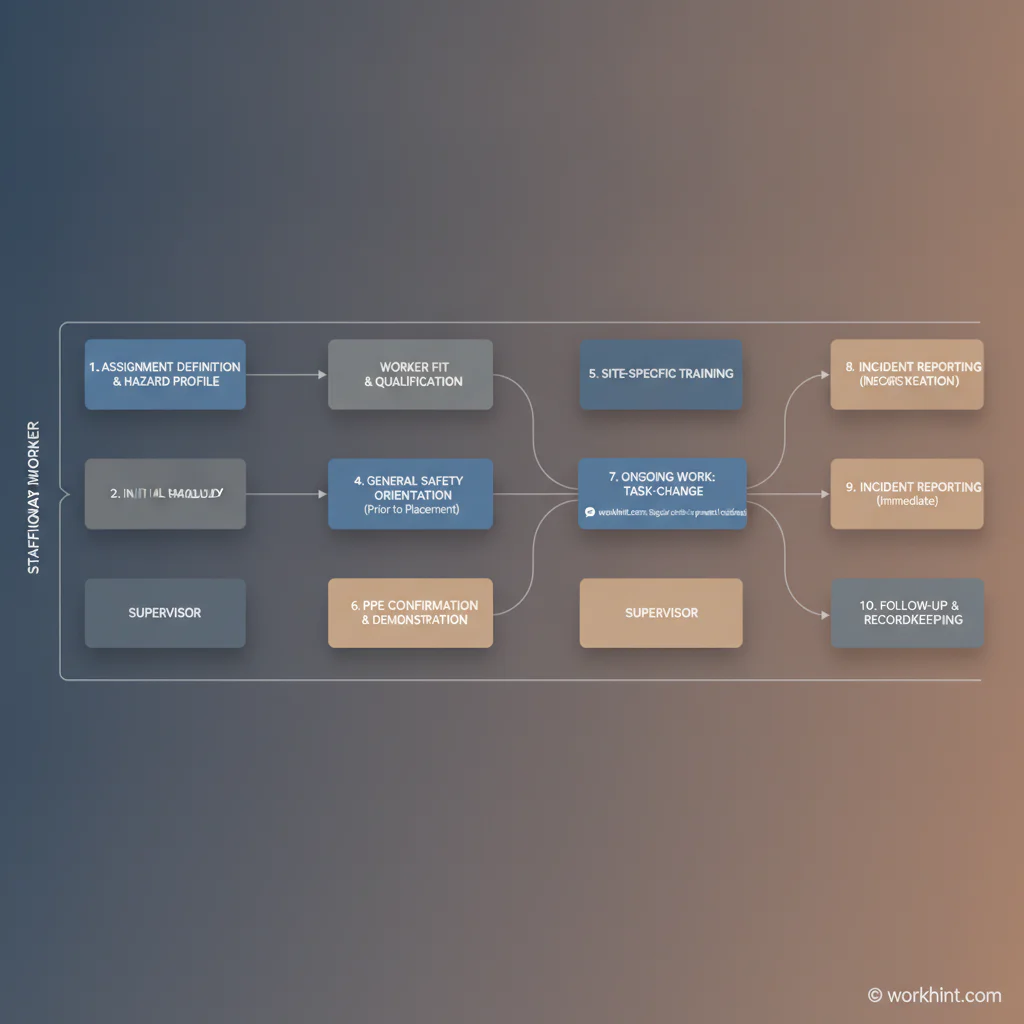
A good temporary worker safety workflow starts before a requisition is filled and continues after the shift begins. Use this sequence as the operating baseline.
- Define the assignment. Capture job title, tasks, schedule, location, supervisor, equipment, required credentials, physical requirements, and whether the worker may be reassigned.
- Review hazards before placement. The host employer should share anticipated hazards, PPE requirements, training requirements, restricted tasks, emergency procedures, and any site conditions that affect placement.
- Confirm worker fit. The staffing agency should match the worker to the assignment based on documented requirements, not just availability.
- Complete general orientation. The agency should cover reporting channels, assignment expectations, who to contact, and how safety concerns should be escalated.
- Complete site-specific training. The host should train the worker on actual worksite hazards, equipment, PPE, safe work practices, emergency procedures, and supervisor expectations before work begins.
- Document completion. Keep time-stamped records of assignment requirements, training completion, acknowledgments, PPE issue, supervisor assignment, and unresolved exceptions.
- Monitor task changes. If the worker’s duties, location, shift, equipment, or hazard exposure changes, trigger a new review before the changed work starts.
- Route incidents and concerns. Workers need one clear path for concerns, while agency and host contacts need automatic notification and follow-up ownership.
- Review and improve. After incidents, near misses, complaints, or assignment changes, review what broke in the workflow and update the responsibility map.
What to document before work starts
The documentation should be specific enough to prove that the safety workflow happened, but simple enough that teams actually use it. At minimum, keep assignment details, hazard disclosures, training requirements, training completion records, PPE requirements, supervisor names, worker acknowledgments, escalation contacts, incident reporting instructions, and any restrictions on tasks.
Washington State Labor and Industries gives a useful operational example: its temporary worker safety guidance calls for identifying hazards, reviewing host employer safety conditions, documenting training, and confirming site-specific training. Even if a company operates elsewhere, that structure is a strong model for making responsibilities visible.
Common temporary worker safety mistakes
- Assuming the agency handled everything. The host still controls the worksite, task changes, tools, and daily supervision.
- Assuming the host handled everything. The agency still needs to ask, document, orient, communicate, and follow up with the worker.
- Using generic training only. General onboarding does not replace site-specific hazard, equipment, emergency, and PPE training.
- Changing duties without a new review. Temporary workers are often moved quickly, but new tasks may create new training or safety requirements.
- Relying on email records. Safety records should be easy to retrieve by worker, assignment, site, date, and responsible owner.
Where Workhint fits
Workhint fits when temporary worker safety needs to become a repeatable operating workflow across staffing agencies, host employers, supervisors, workers, HR, operations, and safety teams. Instead of scattering assignment requests, hazard disclosures, training confirmations, incident reports, and follow-ups across email and spreadsheets, a business can build the process as role-based steps.
For example, Workhint can help structure the worker request, collect assignment details, route hazard review, require training confirmation, manage supervisor acknowledgments, track unresolved safety exceptions, notify owners after an incident, and keep the safety record connected to the worker and assignment. The point is not to replace qualified safety judgment. It is to make the workflow visible enough that the right judgment happens before work starts.
FAQ
Who is responsible for temporary worker safety?
Responsibility is shared. OSHA says staffing agencies and host employers are jointly responsible for maintaining a safe work environment for temporary workers, though the exact responsibilities depend on the facts of the assignment and worksite.
What safety training should temporary workers receive?
Temporary workers should receive general orientation plus site-specific training for the actual hazards, tasks, equipment, PPE, emergency procedures, and reporting channels they will use on the assignment.
Should staffing agencies inspect host worksites?
Staffing agencies should understand the assigned work environment, ask about hazards and controls, and document what the host employer provides. Higher-risk assignments may require more formal review by qualified safety personnel.
What should happen when a temporary worker’s task changes?
The host employer and staffing agency should treat task changes as a new safety review trigger. The worker may need new hazard communication, training, PPE, supervision, or assignment documentation before starting the changed task.
How can companies reduce temporary worker safety gaps?
Use a shared workflow with named owners, required fields, training gates, incident routing, and assignment-change triggers. The safest process is visible, documented, and reviewed when the work changes.
Conclusion
Temporary worker safety depends on coordination. Staffing agencies and host employers each hold part of the picture, so the workflow has to connect assignment details, hazard review, training, supervision, incident reporting, and documentation before the worker starts. When those responsibilities are visible, temporary workers get clearer protection, supervisors know what must happen next, and the business has a stronger record of how safety was handled.
Leave a Reply