


Use this checklist to compare vendors clearly, reduce buying risk, and turn a messy selection process into a defensible decision.
A vendor evaluation checklist helps a business compare suppliers, agencies, software platforms, contractors, and service partners using the same decision standard. Without one, teams often choose based on price, relationships, or a polished demo.
The better approach is to define the criteria before reviewing vendors, collect the same evidence from each option, score consistently, and keep a record of why the decision was made. This is especially important when a vendor will touch customer data, finance, operations, compliance, delivery quality, or a core workflow.
This resource gives you a practical checklist, weighted scorecard, and workflow you can adapt for procurement, operations, HR, finance, technology, or professional services.
What’s included
- A vendor evaluation workflow from requirements to final approval.
- A checklist of criteria to review before selecting a vendor.
- A weighted vendor scorecard template.
- Common mistakes to avoid when comparing suppliers.
- Guidance on turning the checklist into a managed operating process.
How to use this vendor evaluation checklist
Start before proposals come in. The CIPS supplier evaluation guidance emphasizes collecting and analyzing supplier data, then setting criteria to narrow potential suppliers. That order matters. If the team invents criteria after seeing the options, the process becomes vulnerable to bias.
- Define the business need. Document the problem, required outcome, users affected, constraints, budget range, timing, and decision owner.
- Set must-have requirements. Separate non-negotiables from preferences.
- Choose evaluation criteria. Use the categories below, then adjust weighting based on the risk and importance of the purchase.
- Request comparable evidence. Ask each vendor for the same information: proposal, pricing, implementation plan, references, security details, service commitments, and contract terms.
- Score independently first. Have evaluators score before the group discussion so the loudest person does not shape every rating.
- Record the final decision. Keep the scorecard, risks, approvals, and next steps with the vendor record.
Vendor evaluation checklist
Use this checklist for each vendor. For strategic, regulated, expensive, or operationally critical vendors, treat each section as required.
1. Business fit
- The vendor clearly understands the business problem.
- The proposed product or service matches the required scope.
- The vendor can support the team’s volume, locations, users, languages, or operating model.
- The vendor has relevant experience with similar companies or use cases.
2. Quality and delivery capability
- The vendor can explain how work will be delivered, reviewed, and improved.
- References, case studies, samples, demos, or pilots support the vendor’s claims.
- Service levels, timelines, escalation paths, and ownership are clear.
- Quality standards, acceptance criteria, and review checkpoints are documented.
3. Risk, compliance, and security
- Data access, privacy, confidentiality, and security obligations are understood.
- The vendor can provide required certifications, insurance, licenses, or compliance evidence where relevant.
- Contract terms cover confidentiality, intellectual property, liability, termination, data handling, and subcontractors.
- Operational continuity is considered, including backup contacts, outage handling, and transition support.
- Risks are documented with owners and mitigation steps before approval.
4. Commercial terms
- Total cost is clear, including setup, usage, support, renewal, training, migration, and cancellation costs.
- Pricing is comparable across vendors, not hidden behind different units or assumptions.
- Payment terms, renewal terms, discounts, and price increases are understood.
- The expected value justifies the cost and implementation effort.
5. Implementation and adoption
- The vendor provides a realistic implementation plan with milestones and owners.
- Internal work required from your team is visible.
- Migration, integration, onboarding, and change management needs are documented.
- Success metrics are agreed before launch.
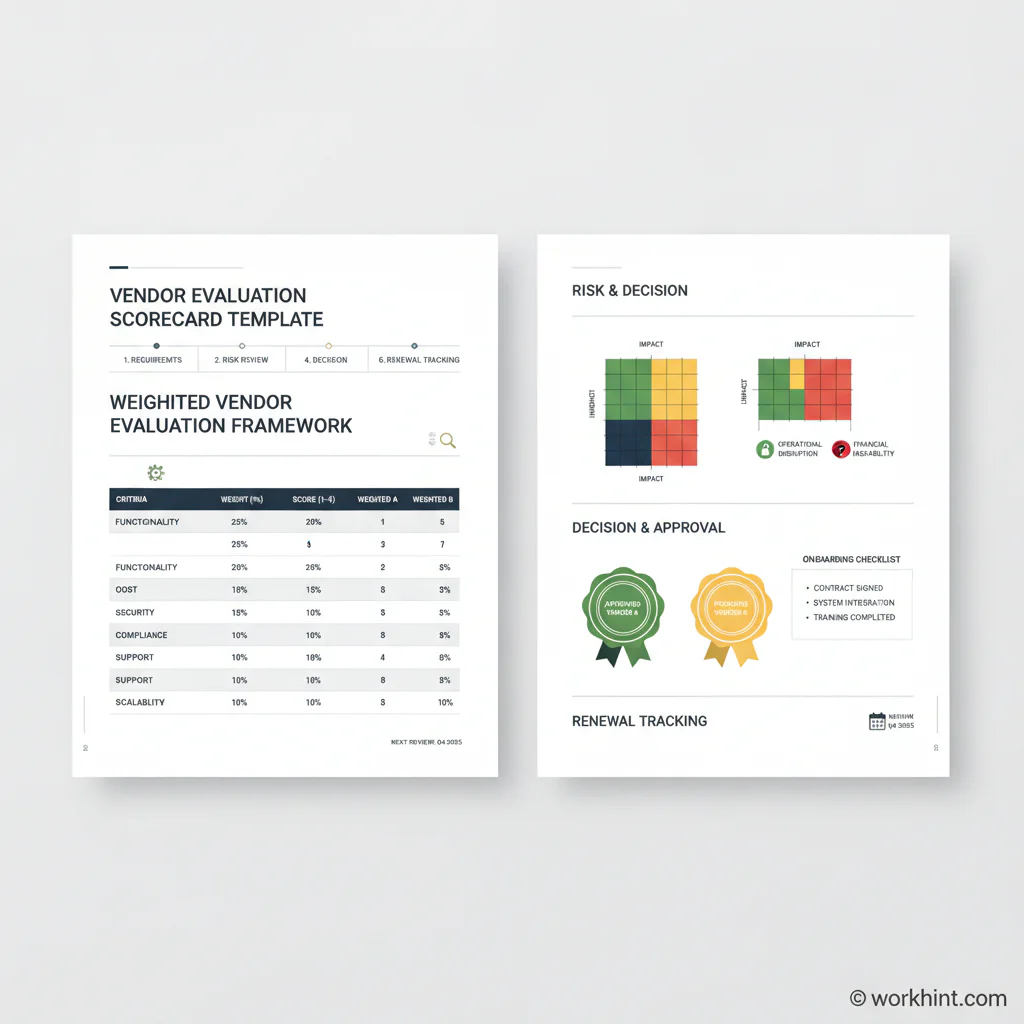
Vendor evaluation scorecard template
The scorecard should be simple enough that evaluators will actually use it. A five-point scale works well: 1 means poor fit, 3 means acceptable, and 5 means strong fit. Weight the criteria so price does not overwhelm risk, quality, or implementation readiness.
| Criteria | Suggested weight | What to score |
|---|---|---|
| Business fit | 25% | Scope match, use case fit, stakeholder needs, strategic relevance |
| Quality and delivery | 20% | Experience, delivery model, references, service levels, capacity |
| Risk and compliance | 20% | Security, privacy, insurance, legal terms, continuity, regulatory needs |
| Commercial terms | 15% | Total cost, contract flexibility, renewal terms, payment model |
| Implementation readiness | 15% | Timeline, onboarding, integrations, training, internal workload |
| Relationship and support | 5% | Responsiveness, communication, escalation, long-term fit |
Public procurement teams often formalize evaluation criteria because consistency protects the process. The George Washington University procurement guidance lists examples such as qualifications, approach, staff, references, and pricing. Private companies need the same discipline: criteria should be visible before the decision.
Example application
Imagine a company choosing a customer support outsourcing partner. The cheapest vendor looks attractive, but the checklist reveals weak escalation coverage, unclear data handling, and limited experience with the company’s customer segment. Another vendor is 12% more expensive but has stronger references, better coverage, a clearer onboarding plan, and documented security controls.
The scorecard makes the tradeoff visible. Instead of arguing about preference, the team can discuss whether the lower-cost vendor’s risks are acceptable and what mitigation would be required.
Common mistakes
- Starting with demos instead of requirements. A strong demo can hide weak fit.
- Comparing prices without normalizing scope. One vendor may include onboarding and support while another charges separately.
- Ignoring implementation workload. A good vendor can still fail if internal owners, training, migration, and approvals are missing.
- Skipping risk review for familiar vendors. A referral does not replace security, legal, financial, or operational diligence.
- Losing the decision record. A scorecard is useful only if the business can find it later during renewal, audit, or performance review.
Government procurement resources stress documentation for a reason. The Georgia Technology Authority procurement review checklist guide notes that procurement checklists help suppliers and buyers stay aligned through requirements and bidding. The EPA’s procurement template references also include vendor proposal checklists and proposal evaluation criteria.
Where Workhint fits
A checklist is a good starting point, but vendor evaluation becomes stronger when it is part of a live workflow. In Workhint, a team can turn this resource into a vendor intake process with assigned reviewers, permissions, document collection, scorecards, approval steps, risk flags, onboarding milestones, renewal reminders, and reporting.
That matters because vendor selection is rarely a single form. Procurement may own pricing, legal may review terms, security may review data access, operations may validate delivery, and finance may approve spend. Workhint connects those steps into a vendor record that shows what was requested, reviewed, approved, and assigned after selection.
FAQ
What is a vendor evaluation checklist?
A vendor evaluation checklist is a structured list of criteria used to compare suppliers, service providers, software platforms, agencies, or contractors before selection. It helps teams review fit, quality, risk, commercial terms, and implementation readiness consistently.
What should vendor evaluation criteria include?
Most teams should include business fit, delivery capability, references, security, compliance, total cost, contract terms, implementation plan, support model, and scalability. Regulated or high-risk purchases may need deeper review.
How do you score vendors fairly?
Define criteria before reviewing proposals, use the same evidence request for each vendor, assign weights, have reviewers score independently, and document the final decision. Weighted scoring prevents one factor, such as price, from dominating.
Who should be involved in vendor evaluation?
Include the business owner, end users, finance, procurement, legal, security, compliance, and operations when their areas are affected. Smaller purchases may need only two or three reviewers. Critical vendors need broader review.
Conclusion
A vendor evaluation checklist gives teams a practical way to choose partners based on evidence instead of preference. Define the requirements, use consistent criteria, score the options, document the risks, and keep the decision record connected to onboarding and renewal. The result is a cleaner buying process and clearer vendor expectations.
Leave a Reply