


Gig worker management breaks when flexible work moves faster than onboarding, approvals, payment status, and operational ownership.
Gig worker management is the process a business uses to onboard, assign, coordinate, approve, pay, and review flexible external workers without turning every request into a manual chase. It matters when the company relies on short-term workers, on-demand contributors, local service providers, marketplace labor, temporary specialists, or project-based operators.
The goal is not to control gig workers like employees. The goal is to create a clear operating system around the work: who can join, what they are approved to do, how assignments are offered, what evidence confirms completion, when payment is released, and how exceptions are handled.
What’s in this article?
- Why gig worker management needs a real process.
- The difference between managing work and creating classification risk.
- A step-by-step workflow for onboarding, assignments, approvals, and payouts.
- A practical operating table for owners and records.
- Where Workhint fits when gig work needs to scale.
Why gig worker management matters
Gig work can help a business respond to demand without adding permanent headcount. But flexibility creates operational pressure. If worker records, onboarding documents, assignment rules, communications, completion proof, and payment status live in different tools, the team loses visibility fast.
Classification also matters. The IRS guidance on independent contractors and employees emphasizes the full relationship and the right to direct and control the worker. The Department of Labor’s FLSA employment relationship guidance looks at whether the worker is economically dependent on the business or in business for themself. That does not mean every gig worker is an employee. It means the operating model should be intentional and reviewed with qualified advisors when classification is sensitive.
The Bureau of Labor Statistics describes alternative work arrangements as including independent contractors, on-call workers, temporary help agency workers, and workers provided by contract firms. A business may use several of these models at once, which is why one generic onboarding checklist is rarely enough.
Core principles for managing gig workers
A strong gig worker management process starts with five principles.
- Separate worker type from work type. A delivery driver, brand ambassador, translator, field technician, healthcare shift worker, or content reviewer may need different records, checks, permissions, and payment rules.
- Approve eligibility before assigning work. Do not wait until payment or customer delivery to discover that documents, insurance, licenses, tax forms, or platform access are missing.
- Define assignment rules. Clarify location, skill, availability, acceptance window, pay basis, cancellation rules, and completion evidence.
- Manage outcomes, not daily supervision. External workers should usually be coordinated through clear scopes, jobs, shifts, service levels, and deliverables rather than employee-style management.
- Connect completion to payout readiness. Payment delays often come from missing proof, unclear approvals, or exceptions that finance cannot resolve.
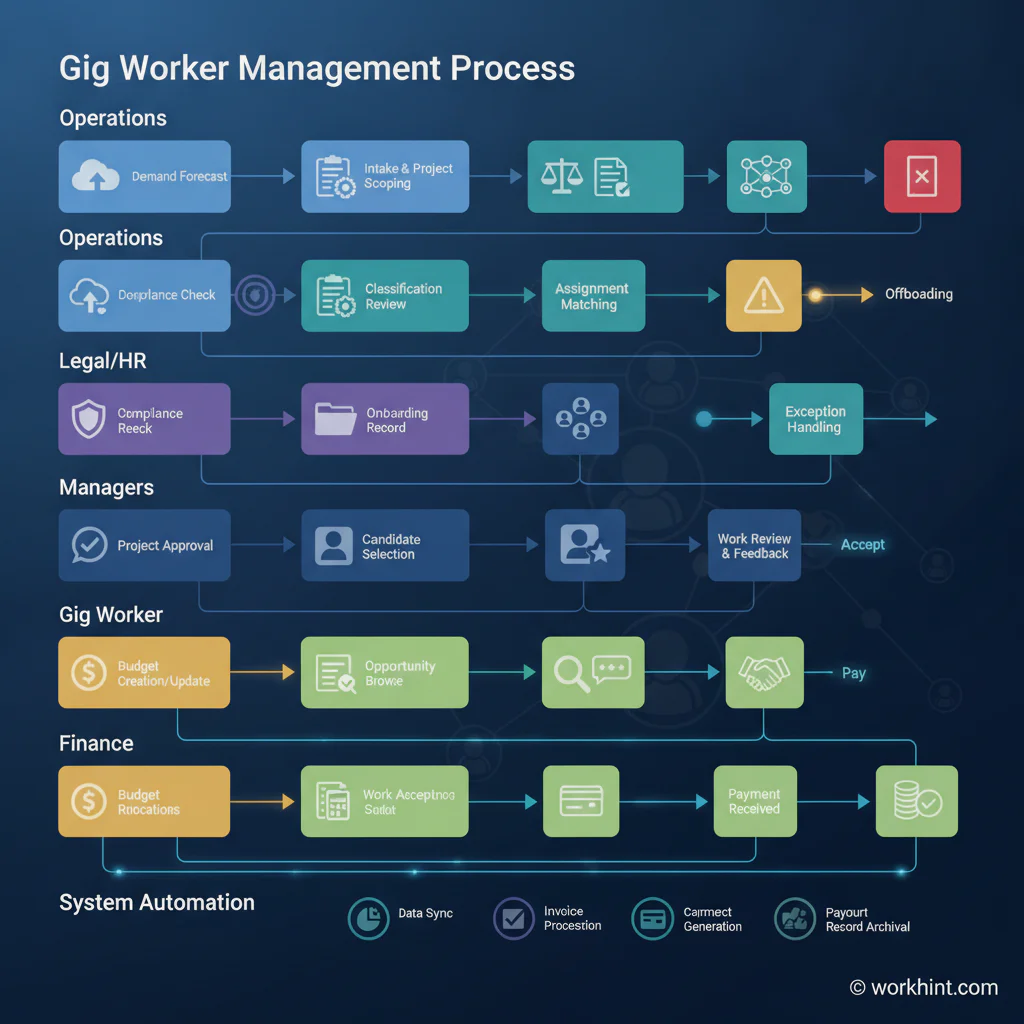
Gig worker management workflow
Use this workflow when flexible work depends on many contributors, fast assignment cycles, or repeatable service delivery.
- Forecast demand. Identify the type of work, expected volume, service area, required skills, peak periods, and backup capacity.
- Define the worker model. Decide whether the work uses independent contractors, staffing partners, temporary workers, vendors, employees, or a blended model. Involve legal, HR, finance, or tax advisors where classification risk exists.
- Create intake and approval criteria. Collect business justification, location, work category, risk level, budget owner, required credentials, insurance needs, and payment method.
- Onboard the worker record. Gather the correct agreement, tax documentation, identity or business verification, role information, payment details, access requirements, and communication preferences.
- Match assignments clearly. Offer or route work based on eligibility, skill, geography, availability, language, certification, rate, or customer requirement.
- Track acceptance and completion. Capture acceptance, start time, completion evidence, service notes, customer confirmation, manager approval, or milestone acceptance.
- Route exceptions. Escalate no-shows, missed documentation, failed quality checks, disputes, safety incidents, late cancellations, or payment holds to named owners.
- Release payment readiness. Finance should see the worker record, approved work, payment terms, invoice or payout trigger, tax status, and exception history before release.
- Review performance and availability. Measure reliability, completion quality, response time, customer feedback, dispute rate, and repeat engagement fit.
- Renew, pause, or offboard. Remove access, close open assignments, preserve records, settle approved payments, and decide whether the worker remains eligible for future work.
Operating table for gig worker management
| Workflow area | Primary owner | Record to maintain | Common failure |
|---|---|---|---|
| Demand planning | Operations | Volume forecast, location, skill need | Hiring or sourcing too late |
| Worker model | Legal or HR | Classification review, engagement type | Using the wrong model for the control level |
| Onboarding | Operations | Agreement, documents, credentials, payment setup | Assigning work before eligibility is complete |
| Assignment | Manager or dispatcher | Offer, acceptance, location, deadline, scope | Unclear responsibility or duplicate assignment |
| Completion approval | Business owner | Proof of work, service note, acceptance decision | Approving from memory instead of evidence |
| Payout readiness | Finance | Approved amount, terms, exceptions, tax status | Delayed payment because records are incomplete |
Common mistakes
Building the process around chat. Chat is useful for updates, but it should not be the system of record for eligibility, assignments, approvals, exceptions, or payments.
Using one workflow for every worker type. A platform driver, temp agency worker, freelance designer, clinical contractor, and local service provider may all be flexible workers, but they do not carry the same risk, access, or payment requirements.
Skipping the exception path. Gig work is fast-moving. No-shows, late cancellations, disputed work, safety concerns, quality failures, and customer complaints need defined owners and status rules.
Separating operations from finance. Finance cannot pay confidently when assignment status, completion proof, tax records, and approval evidence sit outside the payment workflow.
Where Workhint fits
Workhint fits when gig worker management needs to become a live operating system instead of a spreadsheet, form stack, and message thread. A team can use Workhint to structure intake, worker records, role-based access, onboarding steps, assignment rules, approvals, exception routing, payment readiness, and reporting in one workflow.
For example, operations can define eligible work categories, legal or HR can review the worker model, managers can assign approved workers to jobs, workers can submit completion evidence, finance can see payment readiness, and leaders can review reliability or capacity trends. Workhint does not replace legal judgment or payroll compliance. It helps the business run the process consistently once the operating model is defined.
FAQ
What is gig worker management?
Gig worker management is the process of coordinating flexible external workers through onboarding, assignments, completion approval, payments, records, communication, and performance review.
How is gig worker management different from employee management?
Employee management usually includes ongoing supervision, schedules, payroll, benefits, and company-directed work. Gig worker management should focus on eligibility, assignments, outcomes, approvals, and records while respecting the correct worker model.
What should a gig worker onboarding process include?
It should include worker type, agreement, tax or business documentation, eligibility checks, required credentials, payment setup, access rules, communication expectations, assignment categories, and offboarding rules.
How do businesses reduce risk when managing gig workers?
They should define the worker model before work starts, review classification-sensitive roles with qualified advisors, avoid employee-style control when using contractors, maintain records, and connect assignments to clear scopes or service outcomes.
What metrics matter for gig worker management?
Useful metrics include fill rate, acceptance rate, completion rate, no-show rate, time to onboard, approval cycle time, payment delay, dispute rate, quality score, and repeat engagement rate.
Conclusion
Gig worker management works when the business has a clear process around flexible work. Start with the worker model, then connect onboarding, eligibility, assignments, completion evidence, exceptions, payments, and review. The better the operating system, the easier it becomes to scale gig work without losing visibility, creating avoidable risk, or frustrating the people doing the work.
Leave a Reply