


Use this checklist before signing so business terms, legal risks, approvals, and future obligations do not get missed.
A contract review checklist helps business teams review agreements consistently before they sign, renew, or send a document to legal. The goal is not to replace legal advice. The goal is to catch missing business terms, unclear obligations, approval gaps, and obvious risk signals early enough to fix them.
This resource is for operators, founders, finance teams, procurement teams, department leaders, and project owners who handle customer agreements, vendor contracts, service agreements, order forms, statements of work, renewals, and amendments. For complex agreements, involve qualified counsel.
What’s included
- A practical contract review checklist for business agreements.
- A review workflow that separates business, legal, finance, security, and approval responsibilities.
- A red-flag table for terms that should be escalated before signature.
- Post-signature steps for obligations, renewals, and contract records.
How to use this contract review checklist
Use the checklist as a first-pass business review before legal review or executive approval. Read the full agreement, confirm the deal context, compare the document against what was negotiated, and write down open questions. The Washington and Lee University contract review process gives a simple but useful reminder: fill in blanks, review the agreement in advance, and route it to the correct signing authority.
Do not treat the checklist as a one-size-fits-all legal playbook. A low-risk event agreement needs a different review depth than a software contract involving customer data, auto-renewal, indemnity, implementation milestones, or service levels. Use the checklist to decide what can be approved quickly and what needs legal, finance, security, insurance, tax, or leadership review.
Contract review checklist
| Review area | What to check | Owner | Evidence to keep |
|---|---|---|---|
| Parties | Confirm legal names, addresses, entity type, affiliates, and whether the right company is signing. | Business owner | Entity details, vendor or customer record |
| Purpose | Confirm the agreement matches the real business purpose, project, service, purchase, or renewal. | Business owner | Deal notes, request, proposal, order form |
| Scope | Check deliverables, exclusions, milestones, dependencies, service levels, acceptance criteria, and change process. | Project owner | SOW, specifications, stakeholder approval |
| Pricing | Verify fees, taxes, expenses, discounts, payment schedule, invoice timing, late fees, and currency. | Finance | Quote, budget approval, payment terms |
| Term | Review start date, end date, renewal, cancellation window, notice period, and termination rights. | Business owner | Renewal date, notice deadline, owner |
| Risk | Escalate unusual liability caps, indemnity, warranties, damages, insurance, audit rights, and dispute terms. | Legal or leadership | Redline, risk note, approval decision |
| Data and IP | Check confidentiality, data use, security, privacy, intellectual property ownership, license rights, and return of data. | Legal, security, or product | Security review, DPA, IP notes |
| Authority | Confirm the signer has authority under company policy and the approval path matches contract value and risk. | Operations or finance | Approval log, signature authority record |
| Obligations | Capture operational commitments after signature, including reports, notices, implementation tasks, deadlines, and reviews. | Contract owner | Obligation tracker, assigned tasks |
Red flags to escalate before signing
Escalate when a contract changes the economics, control, data exposure, or legal position of the business. The Association of Corporate Counsel contract drafting and review checklist is written for procurement and legal teams, but its broader lesson applies to operators too: a checklist should protect the organization’s interests by making review consistent.
- Blank or vague terms: missing dates, prices, names, deliverables, acceptance criteria, or notice addresses.
- Misaligned scope: the written contract promises more than the team can deliver or less than the buyer expects.
- Automatic renewal risk: renewal or cancellation language creates surprise spend or unwanted commitments.
- Unusual liability: uncapped liability, broad indemnity, consequential damages, or insurance requirements that exceed the deal value.
- Data exposure: personal data, customer data, security obligations, AI data use, or cross-border processing without review.
- IP uncertainty: unclear ownership of work product, deliverables, background IP, licenses, or usage rights.
- Wrong signer: the person signing does not have authority or the approval record is missing.
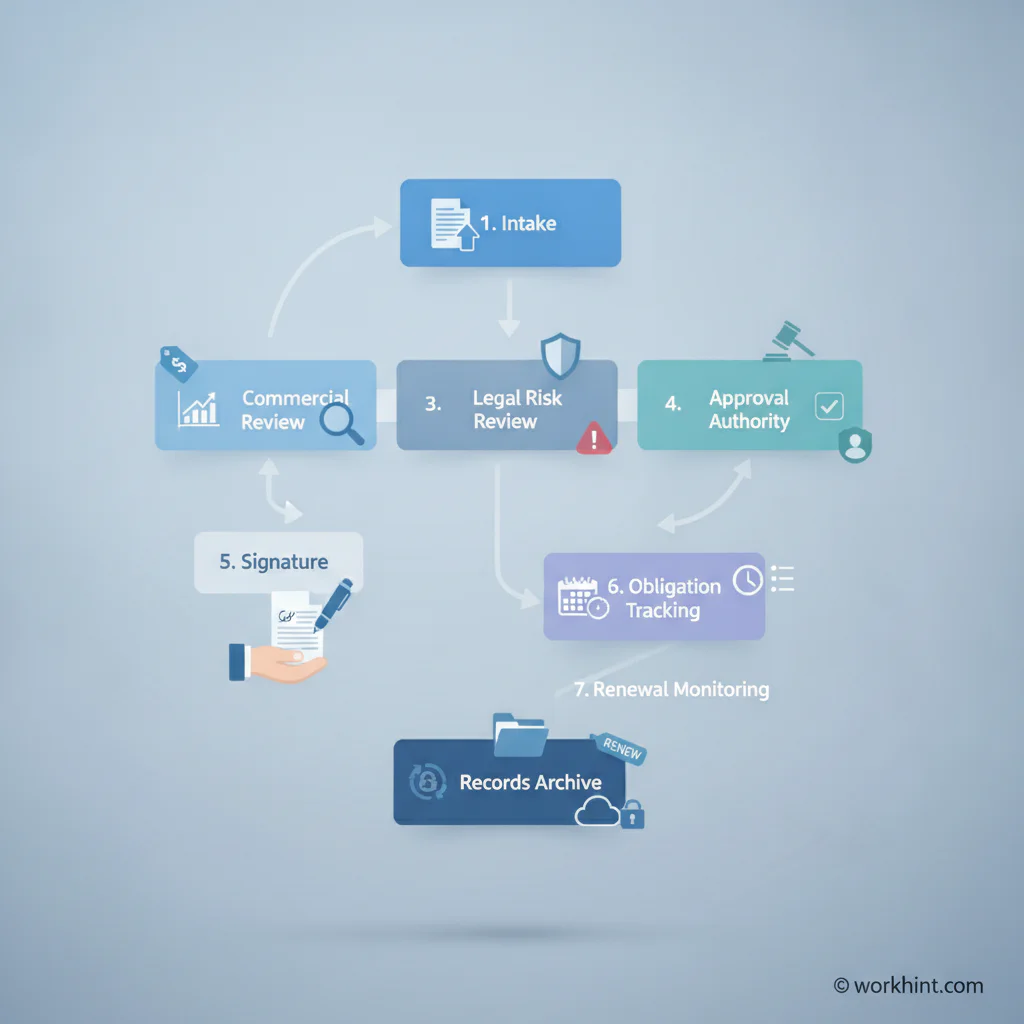
Contract review workflow
- Collect the deal context. Attach the proposal, quote, SOW, emails, negotiation notes, budget approval, and business owner.
- Run the business review. Confirm scope, pricing, timing, deliverables, renewal, cancellation, and operational commitments.
- Tier the risk. Decide whether the contract is low-risk, standard, high-value, data-sensitive, customer-facing, regulated, or strategic.
- Route specialist review. Send the right sections to legal, finance, security, tax, procurement, insurance, or leadership.
- Record decisions. Keep redlines, comments, approvals, exceptions, and the rationale for accepting or rejecting risky terms.
- Confirm signature authority. Match the signer to the company’s delegation of authority before sending for signature.
- Track obligations after signature. Assign owners for implementation, notices, reports, renewals, termination windows, and deliverables.
Example review in practice
A department wants to buy a new analytics platform. The business owner confirms the user count, launch date, success criteria, and budget. Finance checks pricing, taxes, payment timing, and renewal cost. Security reviews data access and integration permissions. Legal reviews confidentiality, liability, indemnity, data processing, termination, and governing law. Operations confirms who can sign and records the renewal date.
Without the checklist, the team might sign quickly and discover later that the contract renews automatically, data exports are restricted, the implementation deadline is unrealistic, and nobody owns cancellation notice. With the checklist, those issues are visible before signature.
Common mistakes
The most common mistake is reviewing only the legal language and ignoring the operating model. A contract can be legally acceptable and still fail if the business cannot meet service levels, reporting duties, notice periods, implementation milestones, or payment deadlines.
Another mistake is waiting until the last day to involve reviewers. The Kansas State Office of General Counsel checklist highlights how a completed intake checklist can make legal review more efficient. Business teams can borrow that principle: give reviewers the context they need, not just the PDF to approve.
Finally, do not let signed contracts disappear into email. Store the final version, approvals, renewal dates, obligations, owner, and key terms in a place the business can find later.
Where Workhint fits
Workhint can help turn a contract review checklist into a live workflow. A team can structure contract intake, route reviews by value and risk, assign finance or security tasks, collect redlines and approvals, confirm signature authority, and track post-signature obligations in one operating system.
The checklist remains the standard. Workhint helps digitize and automate the work around it so business owners, legal, finance, procurement, and operations can see what is waiting, who owns the next review, and which obligations need attention after the contract is signed.
FAQ
What is a contract review checklist?
A contract review checklist is a structured list of business, legal, financial, operational, and approval items to review before a contract is signed, renewed, or amended.
Can a contract review checklist replace a lawyer?
No. It helps business teams prepare a better first pass and catch common issues, but counsel should review material risk, unusual clauses, regulated terms, and agreements the team does not fully understand.
Who should complete the checklist?
The business owner should start it because they know the deal context. Finance, legal, security, procurement, tax, insurance, or leadership may complete specialist sections depending on value and risk.
What contracts need extra review?
Escalate high-value agreements, customer contracts, vendor contracts involving sensitive data, international agreements, long-term renewals, unusual liability terms, IP-heavy work, and any document with unclear obligations.
What should happen after a contract is signed?
Store the final signed agreement, record the owner, assign obligations, track renewal and cancellation dates, capture notice requirements, and connect deliverables or payments to the responsible team.
Conclusion
A useful contract review checklist gives business teams a repeatable way to slow down in the right places. Confirm the parties, scope, money, timeline, risks, approvals, signature authority, and post-signature obligations before the agreement becomes binding. That discipline makes legal review faster, reduces avoidable surprises, and turns contracts into managed business commitments instead of forgotten files.
Leave a Reply