


Use this template to turn a project idea into a decision-ready business case before budget, scope, or ownership drifts.
A business case template helps a team explain why a project should be approved, what it will cost, what value it should create, and what happens if the business does nothing. The best version is not a decorative proposal. It is a decision document that lets leaders compare options, test assumptions, understand risk, and approve work with clear conditions.
Use this resource when requesting budget, starting a cross-functional project, selecting a vendor, changing an operating process, or proposing a new internal system. It is not financial, legal, or investment advice. Treat it as a structured business draft and ask finance, legal, security, or executive sponsors to review the final version when the decision carries material risk.
What’s included
- A copy-ready business case template you can adapt.
- A section-by-section guide for project approval.
- A table showing who should own each part of the case.
- Common mistakes that weaken business cases.
- Guidance on turning the approved case into an operating workflow.
How to use this business case template
Start with the decision you need. Are you asking for budget, permission to start discovery, approval to buy software, authority to hire, or sign-off on a process change? A business case should make one clear recommendation, not collect every possible idea in one document.
Then gather evidence. PMI describes business analysis as a practice that helps teams produce quality requirements, engage stakeholders, and drive successful outcomes. For a business case, that means interviewing the people affected, quantifying the current problem, testing options, and making assumptions visible before leaders approve the work.
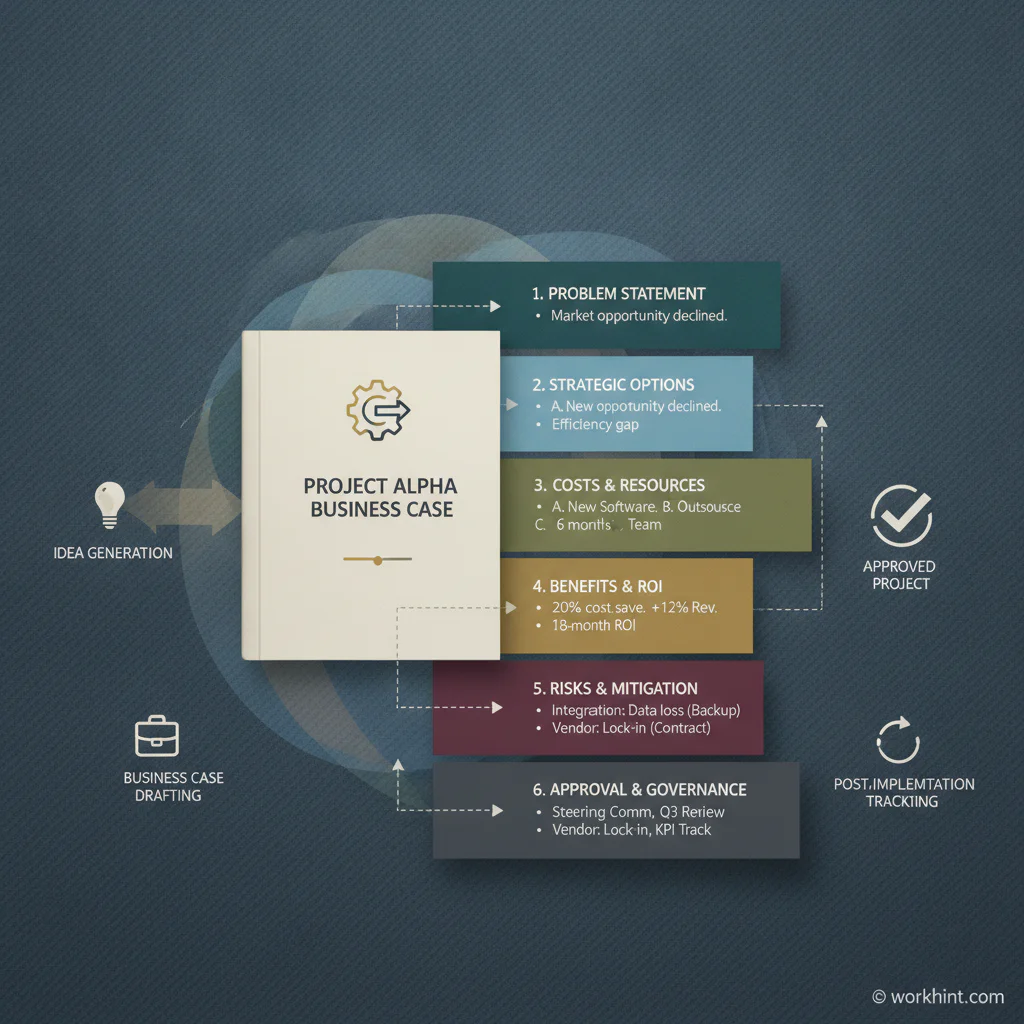
Business case template
| Section | What to write | Owner |
|---|---|---|
| Executive summary | One page covering the problem, recommended option, investment required, expected benefit, key risks, and decision requested. Write this last. | Business owner |
| Problem or opportunity | Describe the current pain in measurable terms: cost, time, quality, revenue, compliance exposure, customer impact, or operational bottleneck. | Business owner |
| Strategic fit | Explain which company goal, customer need, compliance requirement, or operating priority the project supports. | Sponsor |
| Options considered | Compare at least three options: do nothing, recommended option, and one realistic alternative. | Project lead |
| Recommended solution | Define what will be built, bought, changed, or launched. Include scope, exclusions, timeline, and dependencies. | Project lead |
| Benefits | List financial and non-financial benefits with target metrics, expected timing, and measurement owner. | Finance and business owner |
| Costs | Include implementation, software, services, internal labor, change management, training, support, and ongoing operating costs. | Finance |
| Risks and mitigations | Explain delivery, adoption, compliance, data, vendor, budget, timeline, and operational risks, with mitigation owners. | Project lead and risk owner |
| Approval request | State the decision needed, approval deadline, decision maker, conditions, and next step after approval. | Sponsor |
Cost and benefit section
The cost and benefit section should be clear enough for a finance reviewer to challenge it. OMB Circular A-94 explains that benefit-cost analysis compares expected benefits and costs and discounts future values when benefits and costs occur over time. A small internal business case may not need a full economic model, but it should still separate one-time costs, recurring costs, measurable benefits, qualitative benefits, assumptions, and sensitivity points.
Use ranges when estimates are uncertain. For example, show low, expected, and high implementation cost. If a benefit depends on adoption, show the benefit at 50%, 75%, and 100% adoption. This is more useful than pretending the first estimate is exact.
Example approval summary
We recommend approving Option 2: implement a centralized vendor onboarding workflow. The estimated year-one cost is $42,000, with expected annual savings of 480 operations hours, faster vendor approval, fewer missing documents, and clearer audit records. The main risks are low manager adoption and incomplete vendor data. Approval is requested by August 15 so implementation can begin before Q4 procurement renewals.
Common mistakes
- Skipping the do-nothing option: Leaders need to understand the cost of inaction, not only the cost of action.
- Listing benefits without owners: A benefit without a measurement owner usually disappears after approval.
- Hiding operating costs: Training, support, maintenance, and administration often matter more than the initial purchase price.
- Overloading the document: A business case should help make a decision. Put deep evidence in appendices if needed.
- Failing to update the case: PRINCE2-style business case practice treats the business case as something maintained through the project lifecycle, not a document that dies after approval.
Where Workhint fits
Workhint helps when the business case needs to become a live approval and execution workflow. A team can use Workhint to collect intake details, assign review owners, route finance or legal approval, capture risk notes, attach supporting documents, track decision status, trigger implementation tasks, and report whether the approved benefits are actually being measured.
That matters because a business case is often the bridge between strategy and work. Once approved, the proposal usually creates roles, permissions, schedules, documents, handoffs, budget checks, and follow-up reporting. Workhint fits when the organization wants the decision, workflow, accountability, and outcome tracking in one operating system instead of scattered across documents, spreadsheets, and messages.
FAQ
What should a business case template include?
A business case template should include an executive summary, problem statement, strategic fit, options considered, recommended solution, benefits, costs, risks, assumptions, approval request, and success measures.
How long should a business case be?
A small internal business case may be three to five pages. A major investment may require a longer document with financial analysis, legal review, procurement details, and appendices. The executive summary should still be short.
What is the difference between a business case and a project charter?
A business case explains whether the project should be approved. A project charter authorizes the approved project and defines authority, scope, stakeholders, and delivery expectations.
Who should approve a business case?
The approval path depends on cost, risk, and scope. Common approvers include the executive sponsor, finance, operations, legal, IT, security, procurement, and the business owner affected by the project.
Conclusion
A useful business case template helps leaders make a better decision. It defines the problem, compares options, shows the expected value, exposes risks, and states the exact approval needed. The strongest business cases stay connected to execution after approval. They become the baseline for scope, ownership, benefits, costs, and accountability, not a file that disappears once the meeting ends.
Leave a Reply