


Contractor capacity only works when demand, approvals, availability, and payment rules are planned before work starts.
Contractor capacity planning is the process of deciding how much external capacity a business needs, when it needs it, what contractor relationship fits the work, and how that work will be approved, scheduled, delivered, and paid for. It sits between workforce planning and contractor management: planning answers the capacity question before operations rushes to fill gaps.
This article is for teams using independent contractors, freelancers, subcontractors, agencies, staffing partners, or other external contributors. It is not legal advice. Employment, tax, and local labor questions should be reviewed with qualified counsel.
What’s in this article?
- Why contractor capacity planning matters before demand spikes.
- A practical workflow for forecasting contractor capacity.
- A planning table for owners, records, and decision gates.
- Common mistakes that create delivery, budget, and compliance risk.
- Where Workhint fits when contractor capacity needs to become a live workflow.
Why contractor capacity planning matters
Businesses often bring in contractors after the team is already overloaded. That makes the decision feel simple: find help fast. The problem is that rushed contractor capacity creates hidden work. Someone still has to define scope, approve budget, collect documents, decide access, approve deliverables, resolve exceptions, and confirm payment readiness.
General workforce planning guidance from the U.S. Office of Personnel Management frames planning around demand, supply, gaps, and risk. That structure works well for contractor capacity too. The business should know what demand is coming, what internal capacity exists, where the gap is, and whether contractors are the right way to close it.
The U.S. Bureau of Labor Statistics tracks contingent and alternative work arrangements as a distinct labor-market topic, a useful reminder that flexible work is not a side note. Many companies depend on external capacity for projects, service coverage, seasonal demand, specialized expertise, and geographic reach. The more central that capacity becomes, the more deliberate planning needs to be.
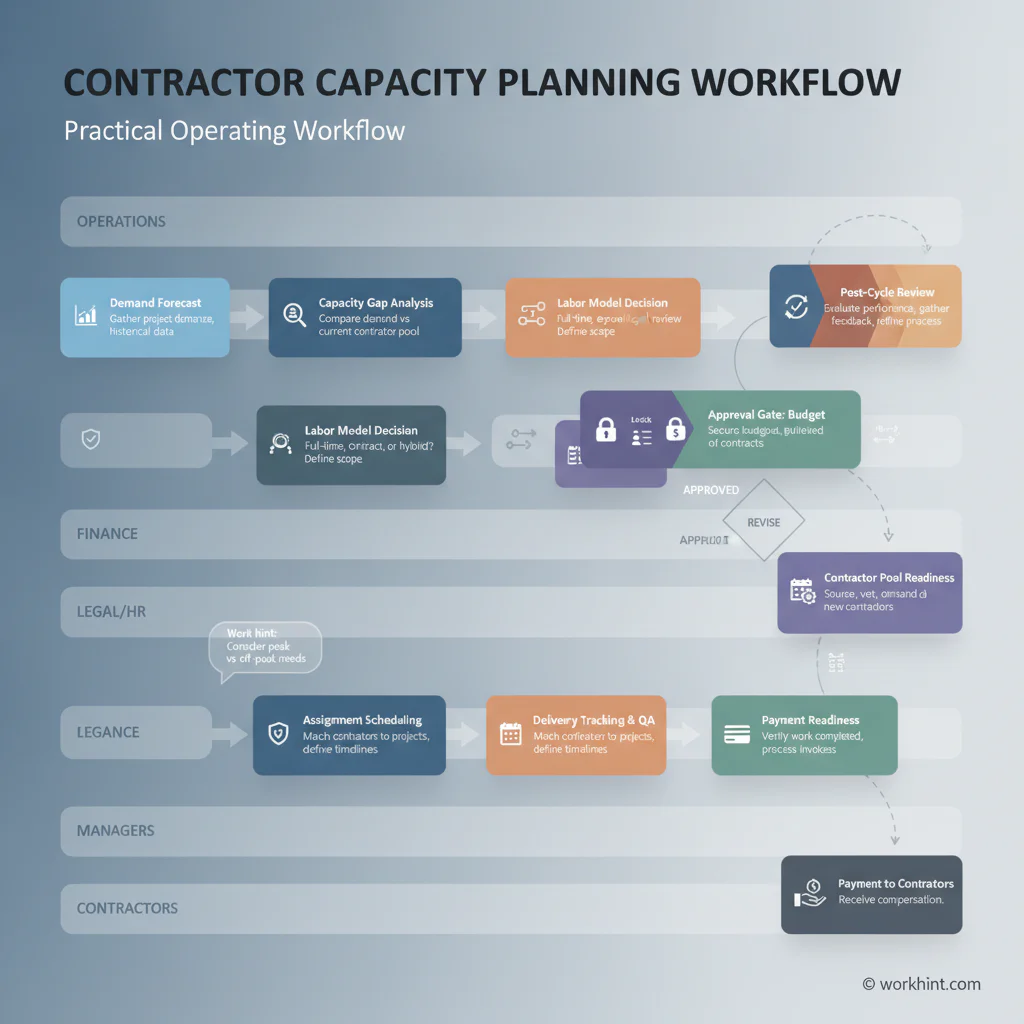
Contractor capacity planning workflow
Start with the work, not the worker. Contractor capacity planning should begin with demand signals such as customer volume, backlog, service requests, implementation commitments, seasonal peaks, location coverage, or internal team bandwidth. Then convert that demand into work units the business can plan around.
- Forecast the demand. Define the expected workload by week, month, location, customer segment, skill, or project type. Avoid a vague statement such as “we need more contractors.” Name the actual work.
- Map current internal capacity. Identify what the employee team can realistically handle without dropping quality, missing deadlines, or delaying strategic work.
- Identify the capacity gap. Compare demand with available capacity. Separate temporary peaks from recurring gaps because they may need different labor models.
- Choose the right external model. Decide whether the work should go to a contractor, freelancer, agency, staffing vendor, subcontractor, managed service provider, or employee hire.
- Approve budget and risk. Finance should confirm spend limits, operations should confirm ownership, and legal or HR should review classification-sensitive cases.
- Build the ready pool. Keep approved contractors, documents, scopes, rates, payment terms, availability, and access needs in one current record.
- Schedule assignments with constraints. Match work to skills, availability, location, contract limits, access needs, and approval owners.
- Track delivery and payment readiness. Capacity is not real until work is accepted and finance knows what can be paid.
- Review actuals after the cycle. Compare planned capacity with delivered work, delays, invoice issues, and contractor availability.
A practical planning table
| Planning step | Owner | Record to keep | Decision gate |
|---|---|---|---|
| Demand forecast | Operations or delivery lead | Workload by period, skill, and priority | Is the gap real enough to source capacity? |
| Labor model choice | Operations with HR or legal | Reason for contractor, agency, staffing, or employee path | Does the relationship fit the work? |
| Budget approval | Finance | Rate, cap, project code, and payment terms | Is spend approved before assignment? |
| Contractor readiness | Operations or vendor owner | Agreement, tax form, scope, availability, and access needs | Can the contractor start without missing records? |
| Assignment scheduling | Manager or dispatcher | Assigned work, deadline, approver, and constraints | Is work matched to available, approved capacity? |
| Closeout review | Operations and finance | Accepted work, invoice status, issues, and next capacity signal | Should capacity be renewed, reduced, or redesigned? |
Classification and control need an early check
Contractor capacity planning should not turn into unmanaged employee-style supervision. The IRS guidance on independent contractors emphasizes looking at the entire relationship and documenting the factors used in classification. The U.S. Department of Labor also explains that worker status under the FLSA depends on the economic realities of the relationship, not just the label in a contract.
For planning purposes, define contractor work around outcomes, scope, deliverables, availability, access, and approval points. If the plan depends on daily supervision, fixed employee-like schedules, indefinite work, or control over how the person performs the work, review the relationship before approving more contractor capacity.
Common mistakes to avoid
- Planning headcount instead of work units. “Five contractors” is not a plan. “Two designers for six launch assets per week” is closer to a capacity model.
- Ignoring manager capacity. Contractors still need scopes, feedback, approvals, and exception handling. If managers are overloaded, adding contractors can add more coordination debt.
- Skipping payment readiness. Define how accepted work becomes invoice-ready, who approves it, and what evidence finance needs.
- Using one process for every contractor. A one-day content project, field subcontractor, and cross-border consultant do not need the same planning depth.
- Failing to review actuals. If planned capacity keeps missing the real workload, the business needs better demand signals, not just more contractors.
Where Workhint fits
Workhint fits when contractor capacity planning needs to move from spreadsheets and message threads into a repeatable operating workflow. A business can use Workhint to capture demand signals, route capacity requests, assign approval owners, collect contractor documents, define roles and permissions, match assignments to available external capacity, track work status, connect accepted work to payment readiness, and report on capacity gaps over time.
The value is not replacing judgment. Finance, legal, HR, operations, and managers still make the important decisions. Workhint gives those decisions a shared system so contractor capacity is visible before work starts and measurable after delivery.
FAQ
What is contractor capacity planning?
Contractor capacity planning is the process of forecasting workload, identifying capacity gaps, deciding where contractors fit, approving budget and risk, scheduling contractor work, and reviewing whether the planned capacity delivered the expected results.
How is contractor capacity planning different from contractor management?
Contractor capacity planning happens before work is assigned. It asks how much external capacity the business needs and what model should fill the gap. Contractor management handles the active relationship after contractors are approved and working.
What should be included in a contractor capacity plan?
Include demand forecast, internal capacity, gap size, required skills, labor model, budget owner, classification review, contractor pool readiness, assignment rules, approval owners, payment terms, and review metrics.
Who should own contractor capacity planning?
Operations or delivery usually owns the planning rhythm. Finance owns budget controls, legal or HR reviews classification-sensitive cases, managers own assignment quality, and contractor owners maintain readiness records.
How often should contractor capacity be reviewed?
Review contractor capacity monthly if external work is ongoing. Review it before seasonal peaks, major projects, new locations, large customer commitments, or any period where internal capacity may not meet demand.
Conclusion
Contractor capacity planning works best when the business treats external capacity as an operating decision, not an emergency reaction. Forecast the work, compare it with internal capacity, choose the right external model, approve budget and risk, keep contractors ready, schedule assignments carefully, and review what actually happened.
Done well, contractor capacity gives the company flexibility without losing visibility. Teams know what help is needed, contractors know what work they are accepting, finance knows what can be paid, and leaders can see whether external capacity is solving the real demand problem.
Leave a Reply