


Contractor reimbursements need enough control to protect the business without turning every expense into a payroll-style process.
Contractor expense reimbursement is not just a finance task. It sits between scope, tax records, project approval, travel rules, invoice review, and contractor classification risk. When the process is loose, contractors pay out of pocket and wait. When the process is too employee-like, the business may create unnecessary control signals around independent work.
The practical answer is to define which expenses are eligible before work starts, require evidence, route approvals by amount and project, and connect reimbursement decisions to the contractor agreement or statement of work. This guide is for operators, finance teams, and business owners who need a repeatable way to reimburse independent contractors, freelancers, consultants, vendors, or field partners without chasing receipts across email.
What’s in this article?
- When contractor reimbursement makes sense
- What to define before the first expense happens
- A contractor expense reimbursement workflow
- A practical reimbursement review table
- Common mistakes that create disputes or compliance risk
- Where Workhint fits when the process needs to scale
Why contractor expense reimbursement matters
Contractor expenses often start small: mileage, software, parking, materials, shipping, local travel, or client-site supplies. The process breaks when those costs are not tied to a clear project, approval owner, receipt standard, or payment path. Finance sees a line item with no context. The manager remembers approving something verbally. The contractor expects payment because the expense helped complete the work.
There is also a tax and classification layer. The IRS explains that businesses may need to report payments made to independent contractors on Form 1099-NEC, and the IRS page on independent contractor versus employee status points to the importance of the relationship and control. The Department of Labor’s economic reality guidance also focuses on whether the worker is in business for themself or economically dependent on the company. That does not mean reimbursement is forbidden. It means the process should support an independent commercial relationship rather than mimic employee expense management without review.
When to reimburse contractor expenses
Reimbursement makes the most sense when the expense is specific to an approved project, outside the contractor’s ordinary cost of doing business, and documented in the agreement, purchase order, or written approval. A consultant who buys a required research dataset for a client project may be reimbursed. A field contractor who pays site parking for a required visit may be reimbursed. A freelancer’s normal laptop, internet plan, accounting software, or coworking space is usually part of their business overhead unless the agreement says otherwise.
Before work starts, define four things: eligible categories, approval thresholds, required documentation, and timing. If travel is involved, companies often use public references such as GSA per diem rates as a benchmark for reasonable lodging, meals, and incidental expense limits. The point is to set an objective standard before the contractor spends money.
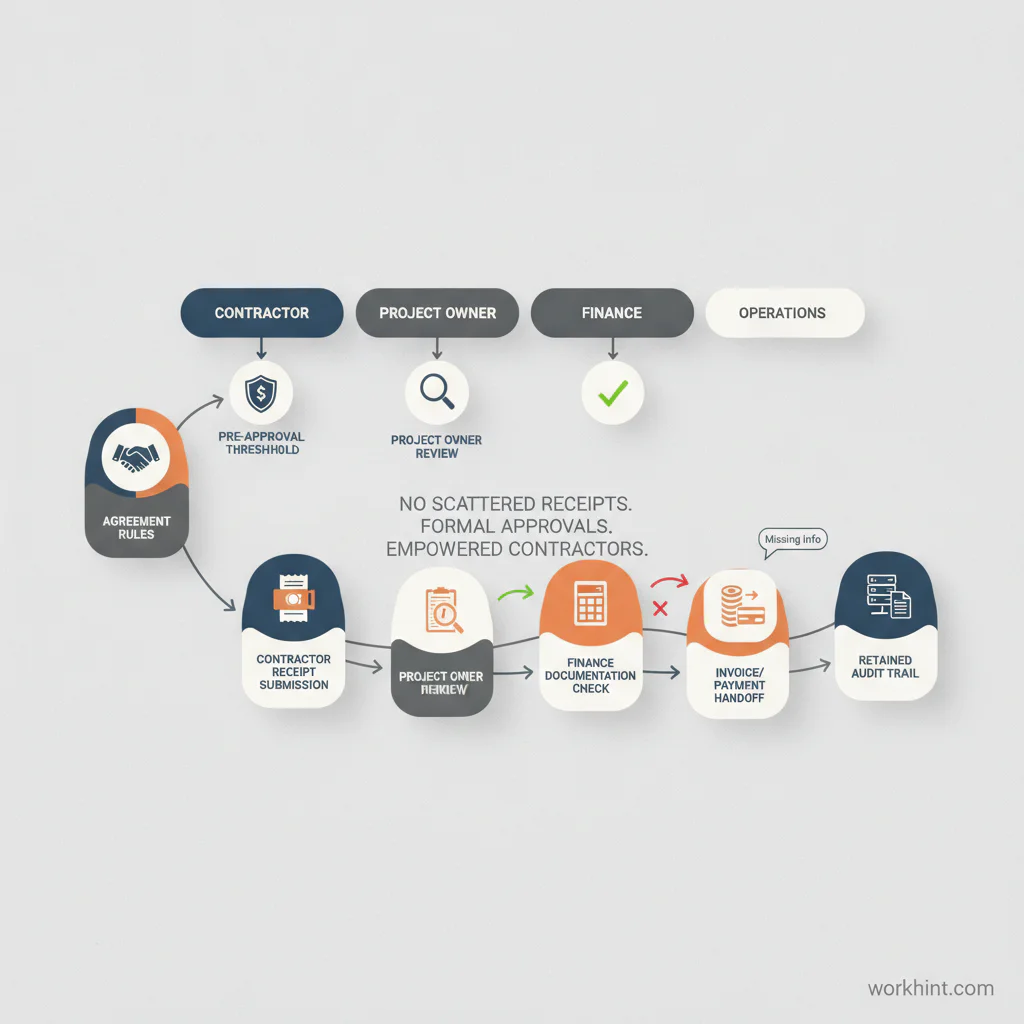
Contractor expense reimbursement workflow
- Define expense rules in the agreement. State whether reimbursable expenses are allowed, which categories qualify, whether pre-approval is required, and whether reimbursements are paid separately or through the invoice.
- Require pre-approval for exceptions. Use simple thresholds. For example, routine mileage under an approved project may only need a receipt or log, while travel, equipment, or software subscriptions may need written approval before purchase.
- Collect the right evidence. Require receipts, dates, business purpose, project code, client or site, currency, tax details where relevant, and the approving manager. For mileage, require origin, destination, date, purpose, and distance.
- Review against scope and budget. The business owner confirms the expense was necessary for the work. Finance confirms documentation, payment method, coding, and whether the amount should be included on the contractor’s payment record.
- Approve, reject, or request more detail. Do not let reimbursement sit in an inbox. A clear response protects cash flow for the contractor and keeps finance from reconciling old claims at month-end.
- Connect reimbursement to payment status. Approved reimbursements should appear on the invoice, payment request, or contractor payment record with a separate label from service fees.
- Retain the audit trail. Store the agreement, approval, receipt, invoice, payment record, and exception notes together for finance review and future disputes.
Contractor reimbursement review table
| Expense type | Default rule | Evidence to collect | Approval owner |
|---|---|---|---|
| Project materials | Reimburse only when required for the agreed work | Receipt, project code, business purpose | Project owner |
| Travel | Require pre-approval unless already covered by the SOW | Itinerary, receipts, rate cap, client/site purpose | Manager plus finance |
| Mileage or local transport | Allow for required site visits with logs | Date, route, purpose, distance or fare receipt | Project owner |
| Software or subscriptions | Approve only when project-specific and time-limited | Receipt, license term, reason existing tools do not apply | Operations or IT owner |
| General overhead | Usually not reimbursed | Exception note if approved | Finance lead |
Common mistakes
The first mistake is approving expenses after the fact without a rule. It feels flexible, but it trains contractors and managers to negotiate every reimbursement separately.
The second mistake is mixing contractor reimbursements with employee expense policy language. Contractors may need receipts, limits, and approvals, but the process should still respect an independent relationship based on scope, deliverables, and agreed commercial terms.
The third mistake is treating reimbursement as a side conversation outside the invoice workflow. If finance cannot see the approval trail, payment slows down or gets approved without context.
The fourth mistake is ignoring currency, taxes, and international payment details. Cross-border reimbursements can raise questions around exchange rates, local tax treatment, and documentation. Ask a qualified advisor before creating a recurring practice.
Where Workhint fits
Workhint fits when contractor reimbursement needs to become a coordinated workflow instead of a manager-forwarded receipt. A business can use Workhint to define reimbursement rules by contractor type, project, country, amount, or expense category; collect receipts and business purpose; route approvals; connect approved expenses to invoices and payment status; and keep the audit trail in one workspace.
For example, a field operations team could create one reimbursement intake for contractors, require pre-approval for travel, assign project owners to validate business purpose, let finance review documentation, and show whether a claim is requested, approved, rejected, or paid.
FAQ
Should independent contractors be reimbursed for expenses?
Sometimes. Reimbursement is appropriate when the agreement allows it, the expense is necessary for the approved work, the contractor provides documentation, and the business has a clear approval rule. Ordinary contractor overhead is usually better handled through the contractor’s fee.
Do reimbursed contractor expenses go on a 1099?
Tax handling depends on the facts, documentation, and payment structure. The IRS provides rules for reporting independent contractor payments, but businesses should confirm treatment with a tax professional.
What should a contractor expense reimbursement policy include?
It should include eligible expense categories, non-reimbursable costs, pre-approval thresholds, receipt requirements, submission deadlines, payment timing, currency rules, exception handling, and who approves each type of claim.
Can reimbursement create contractor classification risk?
Reimbursement alone does not decide classification, but a highly controlled process can add to the overall relationship picture. Keep the process tied to project scope, business purpose, and commercial terms rather than supervising the contractor like an employee.
How fast should contractors be reimbursed?
Set a standard timeline in the agreement or policy. Many businesses align reimbursement review with invoice approval cycles, but urgent travel or materials expenses may need faster handling to avoid pushing business costs onto the contractor for too long.
Conclusion
A good contractor expense reimbursement process is clear before the expense happens. It tells contractors what is eligible, tells managers what they can approve, tells finance what evidence to expect, and keeps payment decisions connected to the work.
The goal is not to reimburse everything or reject everything. The goal is to protect the business, respect the contractor relationship, and make approved expenses easy to review, pay, and audit.
Leave a Reply