


Use this NDA structure before sharing client lists, pricing, product plans, financials, credentials, or operating playbooks with a contractor.
An independent contractor nda template helps a business share sensitive information with an outside worker without leaving confidentiality expectations vague. It is useful when contractors need access to customer data, product plans, internal tools, pricing, vendor terms, technical documentation, or operating procedures.
This is a practical business resource, not legal advice. NDA enforceability depends on jurisdiction, relationship, information type, and contract language. Have counsel review the final agreement before sending it.
What this contractor NDA template includes
This resource gives you a business-ready structure for a one-way contractor NDA, where your company discloses confidential information and the contractor agrees to protect it. It includes clauses to define information, limit use, set protection standards, handle exclusions, require return or destruction, and connect the NDA to contractor onboarding.
The reason to be specific is simple: trade secrets and confidential information are protected only when the business treats them as worth protecting. The USPTO describes trade secrets as information with independent economic value that is not generally known and is subject to reasonable steps to keep it secret. Pair the NDA with access controls, records, and consistent handling.
How to use this independent contractor nda template
Use the template before work starts, before sharing restricted files, or before giving the contractor access to internal systems. The cleanest process is to identify the project, define the confidential information, approve access, collect the signed NDA, then release only the systems and documents required for that scope.
Be careful not to use an NDA as a disguised noncompete or broad gag order. The FTC’s noncompete rule page notes that the federal noncompete rule is not currently in effect, but state law and enforcement priorities still matter. Keep the NDA focused on confidential information, not ordinary future work.
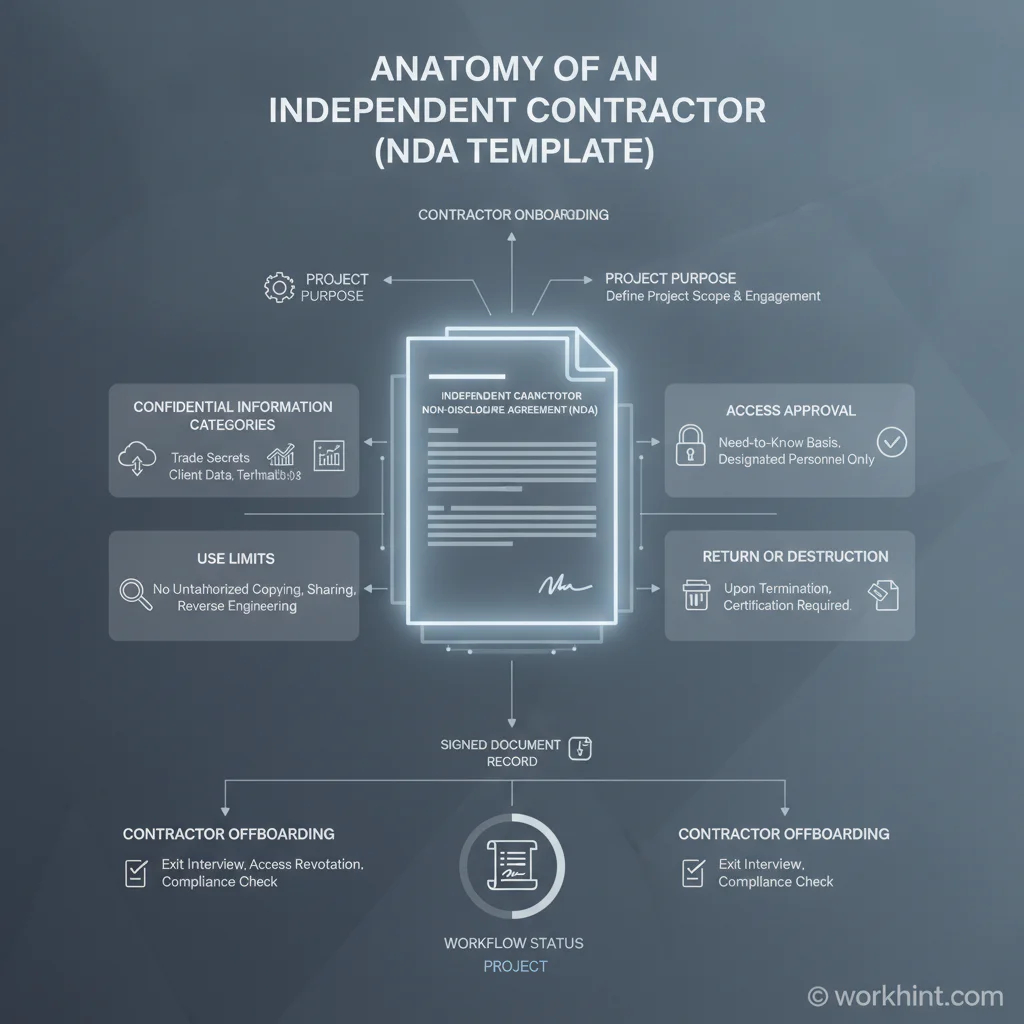
Independent contractor NDA template
| Section | Template language to adapt | Business note |
|---|---|---|
| Parties | This Non-Disclosure Agreement is between [Company Legal Name] and [Contractor Legal Name], effective [Date]. | Use legal names, not nicknames or project labels. |
| Purpose | The contractor may receive confidential information only to perform services under [Project, SOW, or Contractor Agreement]. | Tie access to a specific work purpose. |
| Confidential information | Confidential Information includes nonpublic business, technical, financial, customer, operational, product, pricing, vendor, security, and project information disclosed in any form. | Define categories, but avoid language so broad it becomes meaningless. |
| Exclusions | Confidential Information does not include information the contractor can show was publicly available, already known without restriction, independently developed, or lawfully received from another source. | Standard exclusions prevent overreach. |
| Use limits | The contractor may use Confidential Information only for the approved purpose and may not disclose it to any third party without written permission. | This is the operational core of the NDA. |
| Protection standard | The contractor must protect Confidential Information using reasonable care and at least the same care used to protect the contractor’s own sensitive information. | Add specific security steps for data-sensitive work. |
| Required disclosure | If disclosure is required by law, subpoena, or government process, the contractor must notify the company promptly when legally permitted. | This creates an escalation path. |
| Return or destruction | Upon request or project end, the contractor must return or destroy Confidential Information and certify completion if requested. | Connect this to offboarding. |
| Term | The confidentiality obligations continue for [number] years after disclosure, except trade secrets remain protected as long as they qualify as trade secrets under applicable law. | Counsel should set the right term. |
| No ownership transfer | No rights or licenses are granted except the limited right to use Confidential Information for the approved purpose. | Useful when sharing product, creative, or technical material. |
| Remedies | The parties agree that unauthorized disclosure may cause harm that money damages may not fully remedy. | Have counsel review remedies and venue language. |
Contractor NDA checklist before sending
- Confirm the contractor’s legal name, business entity, email, and signing authority.
- Define the exact project, SOW, engagement, or work purpose that requires access.
- List the confidential information categories the contractor will receive.
- Remove language that tries to restrict ordinary work unrelated to your confidential information.
- Add data security requirements if the contractor will access customer, employee, payment, health, or regulated data.
- Decide whether the NDA should be one-way or mutual.
- Set the obligation term and confirm trade secret language with counsel.
- Connect the signed NDA to onboarding, system access, document permissions, and offboarding.
Example contractor NDA workflow
For a product contractor, the workflow might look like this: the product lead submits the request, legal approves the NDA language, procurement confirms the SOW, the contractor signs, IT grants restricted access, the owner shares required files, and offboarding removes access.
This is where many companies fall short. They collect an NDA once, then lose track of which contractor saw which documents, who approved access, and whether access was removed. The document matters, but the workflow makes confidentiality operational.
Common mistakes to avoid
- Using one generic NDA for every contractor. A designer, finance consultant, developer, and field operator may need different access controls.
- Defining everything as confidential. Overbroad language can make the agreement harder to use and harder to explain.
- Skipping the purpose clause. If the contractor can use information for any reason, the NDA is weaker operationally.
- Ignoring worker classification. Agreements, onboarding, supervision, and tools should not accidentally create employee-style control. Review sensitive workflows with counsel.
- Forgetting protected rights. Do not draft confidentiality terms that interfere with legally protected reporting, cooperation with agencies, or required disclosures. For employee-facing agreements, the NLRB has warned against broad confidentiality provisions that waive protected labor rights.
Where Workhint fits
Workhint helps teams turn a contractor NDA template into a live contractor access workflow. Instead of storing the NDA as a static document, a business can map the process into intake, approvals, required fields, document collection, e-signature status, role-based access, assignments, offboarding, and reporting. For compliance-sensitive contractor resources, contractor compliance software can organize classification checks, required documents, approvals, renewals, and audit trails.
That is useful when different teams hire contractors in different ways. Workhint can help standardize what happens before confidential information is shared, who approves exceptions, and which access steps must close when the project ends.
FAQ
What is an independent contractor NDA?
An independent contractor NDA is a confidentiality agreement used when a business shares nonpublic information with a contractor. It defines what information is confidential, how the contractor may use it, what disclosures are prohibited, and what happens when the project ends.
Should every contractor sign an NDA?
Not always. Use an NDA when the contractor will receive sensitive business, customer, product, financial, technical, security, or operating information. If the contractor does not need confidential information, a lighter agreement or no NDA may be enough.
Is a contractor NDA the same as a contractor agreement?
No. A contractor agreement usually covers scope, fees, deliverables, intellectual property, payment terms, termination, and relationship terms. An NDA focuses on confidentiality. Some companies include NDA clauses inside the contractor agreement; others use a separate NDA.
Can an NDA protect trade secrets?
An NDA can help protect trade secrets, but it is not enough by itself. The company should also limit access, label sensitive materials where appropriate, use permissions, train internal owners, and remove access when the contractor no longer needs it. WIPO’s trade secret guidance emphasizes that confidential business information can qualify when it has competitive value and is kept secret.
Should a contractor NDA be mutual?
Use a mutual NDA when both parties will share confidential information. Use a one-way NDA when only the company is disclosing sensitive information. The right structure depends on the project and should be confirmed before drafting.
Conclusion
An independent contractor NDA template is valuable when specific and connected to work. Define the purpose, describe confidential information, limit use, set expectations, document exceptions, and connect signature status to access and offboarding. The goal is to protect sensitive information while contractors do the work.
Leave a Reply