


Outsourcing works best when external work is managed as a system, not handed off and hoped for.
Outsourcing best practices matter because external teams can expand capacity quickly, but they also introduce scope drift, quality gaps, security risk, payment delays, and unclear ownership. The goal is a repeatable way to decide what should be outsourced, manage delivery, approve work, and close the loop.
Investopedia defines outsourcing as hiring an outside party to perform services or produce goods, often to reduce costs or improve efficiency. In practice, strong outsourcing is a managed workflow with clear expectations, decision rights, and evidence.
What’s in this article?
- The operating model outsourced teams need before work starts
- A practical outsourcing workflow for managers
- A responsibility table for operations, finance, legal, security, and delivery owners
- Where Workhint fits when outsourced work needs structure
Why outsourcing best practices matter
Outsourcing is attractive because it gives businesses access to skills, coverage, and capacity without building every function internally. That can include contractors, agencies, consultants, managed service providers, staffing partners, offshore teams, creative specialists, technical experts, and service networks.
The risk is that outsourced work often crosses multiple internal functions. A manager may define scope, procurement may approve the vendor, legal may review terms, IT may grant access, and finance may handle payment. If those steps live in separate inboxes and spreadsheets, the external team feels slow even when the talent is strong.
Outsourcing also intersects with workforce and compliance questions. The U.S. Bureau of Labor Statistics reported that 11.9 million people were independent contractors on their sole or main job in July 2023. This article is not legal advice, but companies should treat classification, contract terms, tax forms, data access, and local labor rules as part of the workflow.
Outsourcing best practices: the operating model
Before assigning work to an external team, define the operating model. A useful model answers seven questions:
- Scope: What work is being outsourced, what is explicitly excluded, and what output will prove the work is complete?
- Owner: Who owns the relationship, decisions, approvals, and escalation path?
- Engagement model: Is this a freelancer, agency, contractor, vendor, staffing partner, consultant, or managed service provider?
- Access: What systems, data, documents, and channels does the external team need?
- Workflow: How will work be requested, assigned, reviewed, approved, revised, accepted, and paid?
- Metrics: How will quality, timeliness, cost, responsiveness, and business impact be measured?
- Exit: How will final payment, document storage, and access removal happen?
Many outsourcing guides emphasize vendor selection, cost savings, and communication. The practical gap is the handoff between selection and daily execution.
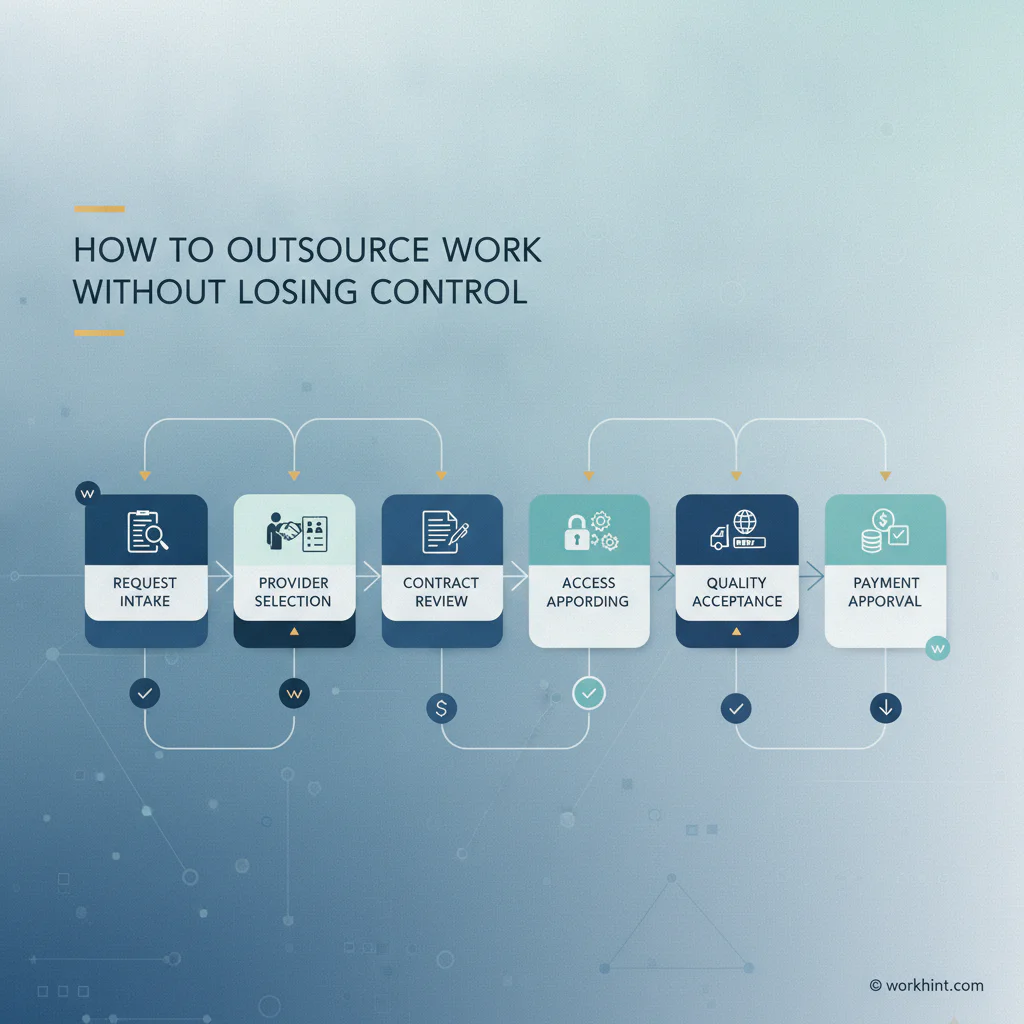
How to outsource work without losing control
Use this workflow before starting a new outsourced function, project, or recurring external relationship.
- Define the business outcome. Start with the result, not the task list: reduce backlog, publish approved assets, or maintain service coverage.
- Choose what should stay internal. Keep strategic decisions, sensitive approvals, customer commitments, and core judgment with internal owners.
- Select the right external model. A freelancer may fit a specialist deliverable, an agency may fit repeatable volume, a staffing partner may fit role coverage, and a managed provider may fit ongoing operations.
- Write a scope that can be managed. Include deliverables, deadlines, acceptance criteria, revision rules, communication cadence, dependencies, and scope-change rules.
- Create approval gates. Require review before contract signature, system access, customer-facing work, milestone acceptance, invoice approval, and renewal.
- Onboard the external team. Provide context, standards, role expectations, required documents, communication channels, access permissions, and named internal contacts.
- Track work in one place. Do not rely only on status calls. Track requests, assignments, blockers, files, decisions, approvals, and payment status.
- Review quality before payment. Connect payment approval to accepted work, not just submitted invoices.
- Close out cleanly. Store deliverables, remove access, complete final payment, and decide whether the provider should be reused.
Outsourcing responsibility table
Outsourcing breaks when ownership is implied. Use a simple responsibility model.
| Area | Primary owner | Decision to make | Evidence to keep |
|---|---|---|---|
| Business need | Team leader or operations | Why external capacity is needed | Request, business case, expected outcome |
| Provider selection | Procurement or department owner | Which provider fits | Evaluation notes, pricing, risk review |
| Contract and compliance | Legal, HR, or compliance | Terms, classification, confidentiality, local requirements | Agreement, required forms, review notes |
| Access and security | IT or security | Which systems and data the external team can use | Access log, approval, removal date |
| Delivery management | Project owner or operations | Assignments, deadlines, blockers, and acceptance | Status updates, deliverables, approval history |
| Payment | Finance | Whether invoice, milestone, or payout is approved | Accepted work, invoice, payment record |
Security, compliance, and quality controls
External work should not mean uncontrolled access. The NIST Cybersecurity Framework emphasizes governance, risk management, access control, and third-party considerations as cybersecurity outcomes. For outsourced work, that means granting only needed access, documenting approval, reviewing sensitive data exposure, and removing permissions when the engagement ends.
For labor and contractor questions, monitor changing rules. The U.S. Department of Labor publishes guidance around employee misclassification. If an outsourced relationship involves individuals working under company direction, build legal or HR review into intake before work starts.
Common outsourcing mistakes
- Outsourcing unclear work. If internal teams cannot define the outcome, an external team cannot reliably deliver it.
- Skipping internal ownership. Vendors do not replace decision rights. Someone inside the business still needs to own priorities, approvals, and tradeoffs.
- Using meetings as the system. Calls help, but they do not replace tracked requests, documented decisions, files, approvals, and payment status.
- Giving broad system access. External teams should receive role-based access tied to the work they actually perform.
- Approving invoices without acceptance criteria. Payment should connect to agreed milestones, deliverables, timesheets, or service levels.
- Forgetting offboarding. Access removal, final files, and reuse decisions should be part of closeout.
Where Workhint fits
Workhint fits when outsourcing needs to become a repeatable operating system instead of a collection of emails, shared folders, vendor calls, and manual payment follow-ups. A business can use Workhint to create intake forms for outsourced work requests, define roles and permissions, route contract and budget approvals, assign work, track milestones, manage review steps, monitor payment status, and report on performance.
That is useful when the business works with freelancers, agencies, contractors, vendors, staffing partners, and distributed teams. Workhint helps connect the parts of outsourcing that usually drift apart: request, approval, onboarding, access, execution, acceptance, payment, and closeout.
FAQ
What are outsourcing best practices?
Outsourcing best practices are the operating rules that help a company manage external work effectively. They include clear scope, internal ownership, provider selection, contracts, compliance review, secure access, delivery tracking, quality review, payment approval, and offboarding.
What should a company outsource first?
Start with work that is important but not core to strategic control, has a clear output, can be measured, and does not require constant executive judgment. Examples include creative production, bookkeeping support, technical implementation, customer operations coverage, research, or specialized project work.
How do you manage outsourced teams?
Manage outsourced teams with named owners, clear deliverables, documented communication rules, role-based access, tracked assignments, review deadlines, acceptance criteria, and payment workflows tied to approved work.
How do you reduce outsourcing risk?
Reduce risk by reviewing the engagement model before work starts, using written scopes and contracts, limiting system access, documenting approvals, reviewing quality before payment, and offboarding external users promptly.
What metrics should outsourced work track?
Track cycle time, quality acceptance rate, revision volume, missed deadlines, budget variance, invoice aging, response time, security exceptions, and whether the outsourced work achieved the business outcome.
Conclusion
Outsourcing is not just a sourcing decision. It is an operating model for getting work done through people and organizations outside the company. The best systems make scope clear, ownership visible, approvals timely, access controlled, work measurable, and payment connected to accepted delivery. When those pieces are in place, external teams become a reliable extension of the business.
Leave a Reply