


Contractor disputes get easier to resolve when evidence, authority, communication, and payment decisions move through one calm process.
How to resolve contractor disputes is a practical operating question for any business that relies on freelancers, consultants, agencies, subcontractors, or other external workers. The disagreement may start with an invoice, missed milestone, quality concern, scope change, late handoff, IP question, or unclear acceptance criteria. If the response happens through scattered messages, the dispute usually gets slower, more emotional, and harder to prove.
This guide is not legal advice. Contract, employment, tax, and dispute-resolution rules vary by jurisdiction and agreement. Use it as an operating framework, and involve qualified counsel when the amount, risk, relationship, or legal position is material.
What’s in this article?
- Why contractor disputes need a defined workflow.
- A step-by-step process for resolving contractor disagreements.
- A dispute triage table for scope, quality, payment, access, and IP issues.
- Common mistakes that make disputes more expensive.
- Where Workhint fits when disputes need better records and routing.
Why contractor dispute resolution matters
Contractor disputes are different from ordinary employee performance issues. The relationship is commercial, usually tied to a contract, statement of work, invoice, milestone, or deliverable. That means the business should resolve the issue through the written agreement, documented approvals, work evidence, and a clear escalation path rather than informal manager preference.
The highest-risk disputes often involve more than money. A payment disagreement may reveal vague scope. A quality dispute may reveal missing acceptance criteria. An access dispute may reveal weak offboarding controls. An IP dispute may reveal that ownership language was not tied to delivery and payment. The U.S. Copyright Office explains in Circular 30 on works made for hire that treatment can depend on the worker relationship, eligible work category, and an express written agreement.
Payment records matter too. The IRS explains that businesses may need to report nonemployee compensation on Form 1099-NEC. A dispute does not remove the need for clean finance records. It makes them more important.
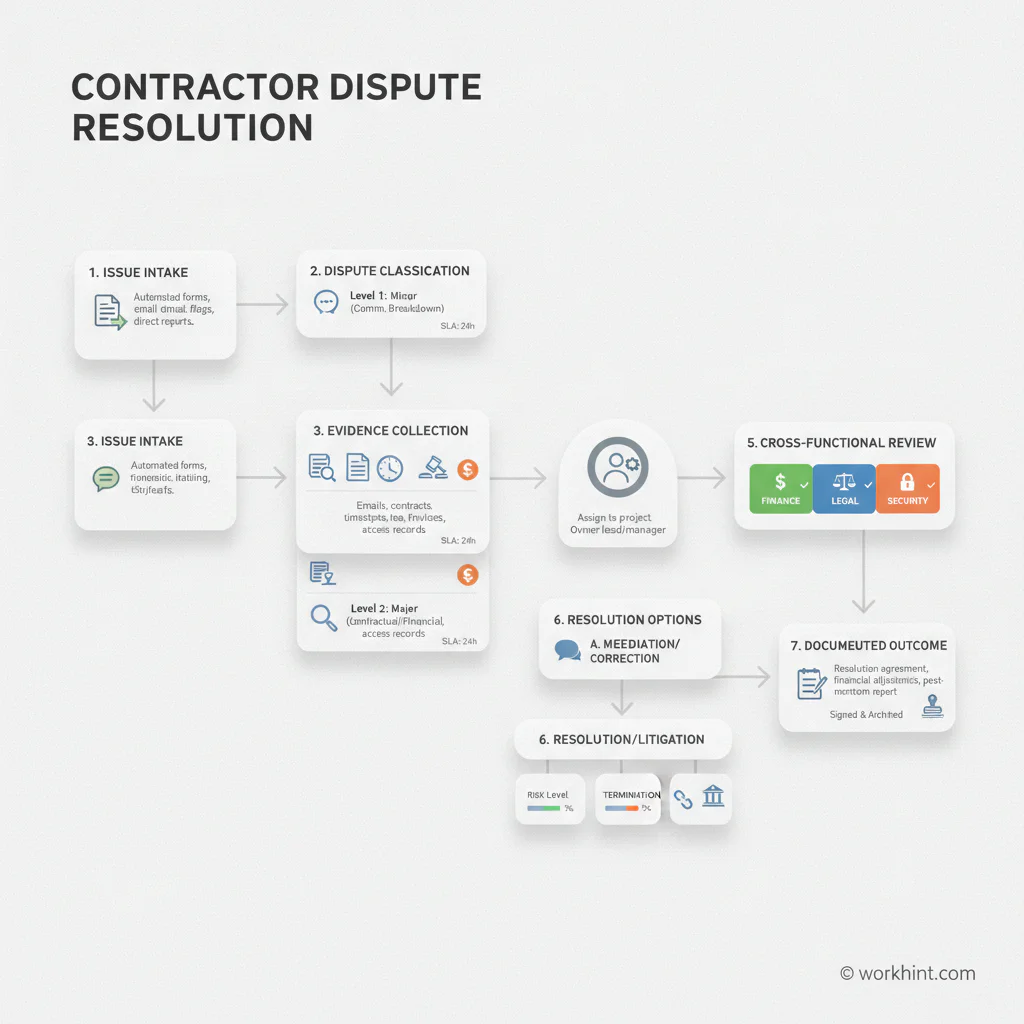
How to resolve contractor disputes
The best process is structured but not theatrical. Move quickly, keep communication factual, and separate what is known from what needs review.
- Pause new informal commitments. Stop approving extra work, access, or payment changes through chat while the dispute is active. Route decisions through the dispute owner.
- Classify the dispute. Identify whether the issue is scope, quality, invoice amount, payment timing, expenses, timeline, access, confidentiality, IP ownership, or behavior. Each type needs different evidence.
- Pull the source documents. Collect the agreement, SOW, change requests, purchase approval, invoices, timesheets, delivery evidence, acceptance notes, emails, and relevant system records.
- Name one business owner. The contractor should not receive conflicting messages from finance, the manager, legal, and operations. Assign one internal owner to coordinate responses.
- Separate undisputed items. If part of the invoice or work is clearly valid, decide whether that portion can be approved while the disputed portion is reviewed.
- Write a neutral issue summary. State the agreement, the disputed item, each side’s position, the evidence available, the business impact, and the decision needed. Avoid blame language.
- Route by risk. Low-risk admin errors may stay with finance or operations. Scope, IP, confidentiality, termination, or large payment disputes may need legal, procurement, executive, or customer-facing review.
- Offer resolution options. Options may include corrected invoice, partial credit, additional delivery, revised acceptance criteria, change order, payment plan, settlement, mediation, contract termination, or formal escalation.
- Document the outcome. Record the decision, payment action, scope update, access change, renewal implication, and owner. If the relationship continues, update the operating workflow so the same dispute does not repeat.
Contractor dispute triage table
Use this table to decide what evidence to gather and who reviews first.
| Dispute type | Evidence to collect | Primary reviewer | Likely resolution path |
|---|---|---|---|
| Scope or extra work | SOW, change requests, messages, approvals, deliverable list | Project owner | Approve change, reject out-of-scope work, or amend SOW |
| Invoice amount | Invoice, rate card, payment terms, accepted milestones, expenses | Finance | Correct invoice, split disputed amount, or approve payment |
| Quality or acceptance | Acceptance criteria, review notes, revision history, delivered files | Manager or operations | Request revision, accept work, or negotiate credit |
| IP or confidentiality | Contract, NDA, assignment clause, file handoff, access logs | Legal or compliance | Confirm ownership, obtain assignment, restrict use, or escalate |
| Access or security | Access request, permission history, project need, offboarding status | IT or security | Remove access, narrow permissions, or document exception |
| Relationship breakdown | Contract terms, communication record, open work, payment status | Business owner | Wind down, mediate, settle, or terminate according to agreement |
Build an escalation path before you need it
Most contractor disputes get worse because the escalation path is invented during the conflict. Build the path before work starts: manager review, finance review, operations review, legal review, executive decision, then external dispute resolution if required by the contract.
If the contract includes mediation or arbitration language, follow it carefully. The American Arbitration Association publishes commercial arbitration rules and mediation procedures for business disputes, and those materials show why filing steps, procedure, cost, and forum should be understood before escalation.
Common contractor dispute mistakes
- Letting multiple people negotiate at once. Conflicting messages weaken the business position and confuse the contractor.
- Arguing from memory. Resolve from contracts, approvals, invoices, files, and delivery evidence, not from what a manager remembers.
- Freezing the entire payment. If only one line item is disputed, holding undisputed amounts may escalate a manageable issue.
- Ignoring IP and access. Some disputes are not just financial. Confirm ownership, file delivery, permissions, and confidentiality obligations.
- Skipping the post-dispute fix. If the same issue can happen again, update the SOW template, approval workflow, invoice review, or access process.
Where Workhint fits
Workhint fits when contractor dispute resolution needs to become part of the external workforce operating system. A team can use Workhint to keep contractor records, agreements, SOWs, approvals, delivery evidence, access status, invoice exceptions, payment readiness, and escalation owners connected.
That matters because disputes are rarely isolated. They touch operations, finance, legal, procurement, security, managers, and the contractor. Workhint helps the business route the issue, preserve evidence, track the decision, and update the process so future contractor work starts with clearer scope, cleaner approvals, and fewer payment surprises.
FAQ
What is the first step in resolving a contractor dispute?
Classify the dispute and collect the contract, SOW, invoice, approvals, delivery evidence, and relevant messages before responding. A factual record prevents the conversation from becoming a debate about memory.
Should a business pay the undisputed part of a contractor invoice?
Often, yes, if the agreement and finance policy allow it. Paying the undisputed portion can preserve the relationship while the business reviews the contested amount. Confirm the approach with finance or counsel for sensitive disputes.
Who should own contractor dispute resolution?
One internal owner should coordinate the response. Depending on the dispute, finance, legal, procurement, security, operations, and the project manager may each review a specific part of the issue.
When should a contractor dispute escalate to legal review?
Escalate when the dispute involves material money, termination, IP ownership, confidentiality, data exposure, regulatory risk, repeated breach, formal claims, or unclear contract language.
How can companies prevent repeat contractor disputes?
After resolution, update the workflow that failed. Common fixes include clearer SOWs, written change requests, acceptance criteria, invoice matching, access controls, and named approval owners.
Conclusion
Contractor disputes are manageable when the business treats them as operating events, not personal conflicts. Start with the agreement, gather evidence, assign one owner, separate undisputed items, route risk to the right reviewers, and document the outcome. The goal is to protect the business, treat external workers fairly, preserve useful relationships where possible, and improve the contractor workflow before the next engagement begins.
Leave a Reply