


Use this template to turn a familiar strategy exercise into clear choices, owners, and next actions.
A SWOT analysis template helps teams evaluate strengths, weaknesses, opportunities, and threats before they commit to a plan. The format is simple, but the best SWOT work is not a brainstorming wall. It is a practical decision tool for comparing internal capability with external reality.
The University of Cambridge Institute for Manufacturing describes SWOT as a way to match environmental trends with internal capabilities. That distinction matters: strengths and weaknesses are mostly inside the organization, while opportunities and threats come from the market, customers, competitors, regulation, technology, supply, or timing.
What’s included
- A copy-ready SWOT analysis template for strategic planning.
- Prompts for strengths, weaknesses, opportunities, and threats.
- A scoring method for separating useful evidence from opinions.
- An action matrix that turns SWOT findings into decisions.
- A business example you can adapt for a product, project, market, or operating plan.
How to use this SWOT analysis template
Start with one clear planning question. Do not run a generic SWOT on the whole company unless the goal is truly company strategy. A sharper question produces better answers: Should we enter this market? Should we launch this service? Why is this project stalling? Where should operations invest next quarter?
Then gather evidence before the workshop. The Rutgers University Libraries guidance emphasizes a realistic, fact-based, data-driven view. For business teams, evidence can include customer feedback, sales notes, renewal data, support tickets, market research, competitor pages, hiring plans, financial reports, delivery metrics, or risk logs.
SWOT analysis template
| Quadrant | What to capture | Useful prompts | Evidence to attach |
|---|---|---|---|
| Strengths | Internal advantages the team can use now. | What do we do better than alternatives? What assets, skills, relationships, data, or processes create leverage? | Performance data, customer proof, win reasons, margin data, delivery metrics. |
| Weaknesses | Internal limits that slow execution or reduce competitiveness. | Where do we lose time, quality, revenue, trust, or capacity? Which problems repeat? | Churn reasons, project delays, defect logs, cost overruns, missed SLAs. |
| Opportunities | External openings the business could pursue. | What market shift, customer need, channel, partnership, technology, or regulation creates upside? | Search trends, pipeline demand, competitor gaps, customer requests, industry reports. |
| Threats | External risks that could damage the plan. | What could reduce demand, increase cost, slow delivery, change buyer behavior, or weaken our position? | Competitor moves, policy changes, vendor risk, budget pressure, supply constraints. |
Step-by-step SWOT workflow
- Define the decision. Write the business question at the top of the template.
- Collect evidence. Ask each participant to add facts before adding opinions.
- Fill the four quadrants. Keep each item specific enough to act on.
- Remove weak entries. Delete vague claims such as “strong team” unless there is proof.
- Score each item. Use impact, confidence, and urgency on a 1 to 5 scale.
- Convert findings into actions. Use the action matrix below instead of stopping at the grid.
- Assign owners. Every selected action needs an owner, due date, trigger, and success measure.
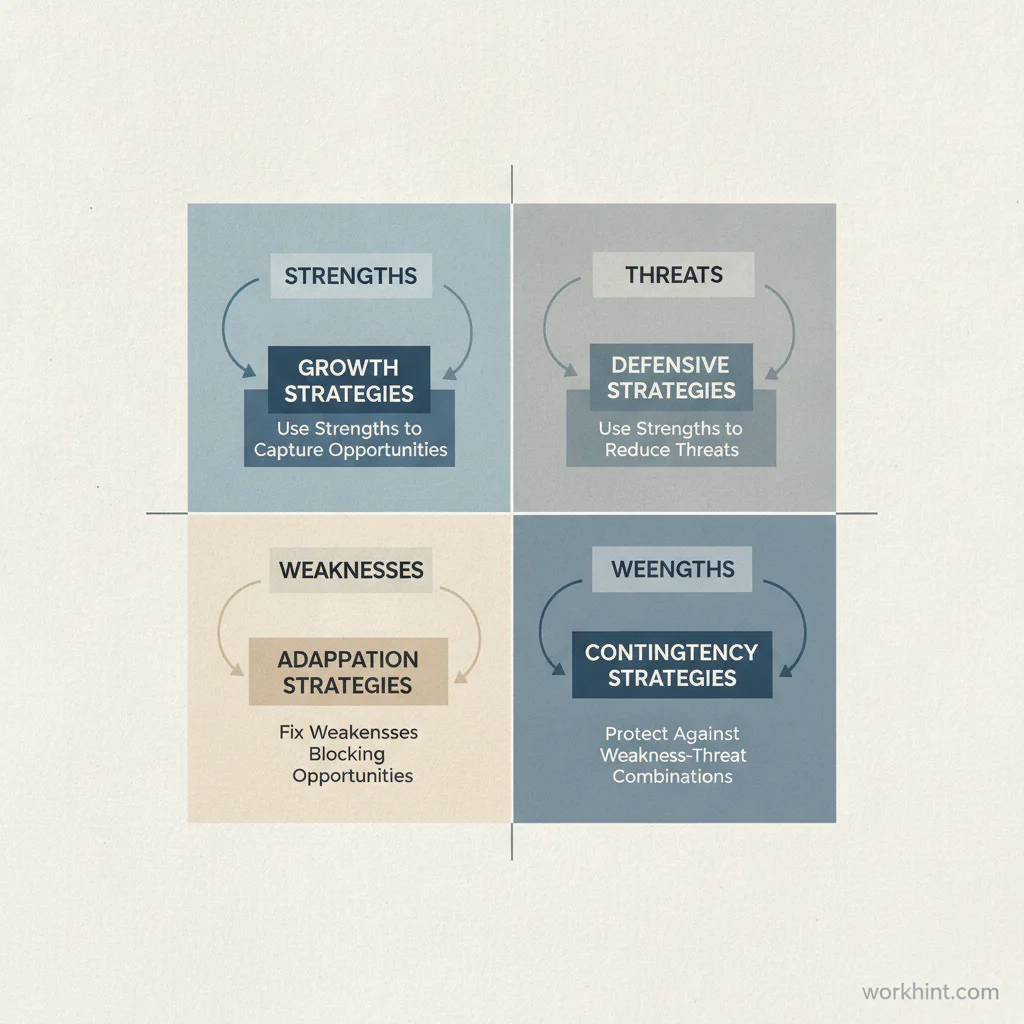
The University of Minnesota Strategic Innovation Office recommends using SWOT to ask how strengths can capture opportunities, how strengths can mitigate threats, what weaknesses block opportunities, and what weaknesses expose the organization to threats. That final step is where the template becomes useful.
SWOT action matrix
| Match | Strategic question | Action type | Example output |
|---|---|---|---|
| Strength + Opportunity | Where can we use an advantage to capture upside? | Invest | Assign sales and product to package a high-demand workflow for an existing customer segment. |
| Strength + Threat | Where can an advantage protect us? | Defend | Use customer success proof to reduce churn risk before a competitor campaign lands. |
| Weakness + Opportunity | What must improve before we can pursue upside? | Fix | Standardize onboarding before expanding into a market with higher implementation volume. |
| Weakness + Threat | Which combination creates the highest risk? | Protect | Create a backup vendor path before supplier delays affect service delivery. |
Example SWOT analysis
Assume a mid-sized services company is considering a new managed vendor program. Its strengths include strong customer relationships, a proven operations team, and high renewal rates. Its weaknesses include manual vendor onboarding, inconsistent approval records, and limited reporting. Opportunities include customer demand for bundled services and a market shift toward outsourced execution. Threats include larger competitors, vendor compliance risk, and margin pressure.
The best strategy is not simply “launch the program.” The SWOT suggests three actions: package the new service around existing customer trust, digitize vendor onboarding before launch, and define margin and compliance controls before the first customer rollout. That is the practical output: a sequenced plan, not a polished matrix.
Common mistakes
- Writing slogans instead of evidence. “Great culture” is not a strategy input unless it affects hiring, retention, delivery, or customer outcomes.
- Mixing internal and external factors. A weak sales process is a weakness. A shrinking market is a threat.
- Listing too many items. Limit each quadrant to the strongest five to seven findings.
- Skipping prioritization. A SWOT without ranking usually produces consensus without action.
- Failing to assign owners. The matrix should feed decisions, projects, policies, or operating changes.
Where Workhint fits
Workhint helps teams turn a SWOT analysis template into an operating workflow. Instead of leaving the analysis in a document, an organization can convert selected actions into roles, owners, approvals, tasks, evidence requests, reminders, dashboards, and follow-up reviews. That is useful when the SWOT points to operational fixes such as vendor onboarding, approval redesign, project intake, compliance checks, or cross-functional handoffs.
The template still does the thinking. Workhint helps digitize and manage the execution around that thinking so decisions do not disappear after the strategy meeting.
FAQ
What is a SWOT analysis template?
A SWOT analysis template is a structured four-part format for capturing strengths, weaknesses, opportunities, and threats. It helps teams assess a business, project, product, market, or strategic decision in a consistent way.
How many items should each SWOT quadrant include?
For most business planning sessions, use five to seven strong items per quadrant. More than that usually means the team has not prioritized.
Who should complete a SWOT analysis?
Include the decision owner, operators close to the work, customer-facing teams, finance or risk when relevant, and anyone who will own the follow-up actions.
How often should a business update a SWOT analysis?
Update it when the decision context changes. For active strategic plans, a quarterly refresh is usually more useful than an annual exercise.
Is SWOT enough for strategic planning?
No. SWOT is a starting point. The University of Kansas Community Tool Box frames SWOT as a tool for planning and decision-making, but the value comes from turning findings into choices, tradeoffs, and action.
Conclusion
A SWOT analysis template is useful because it makes strategy visible. It shows what the organization can use, what it must fix, what it can pursue, and what it must prepare for. The important step is to move from four boxes to owned decisions. Use the template, pressure-test each entry with evidence, rank the highest-value items, and turn the result into a practical action plan.
Leave a Reply