


A contractor SOW should not be signed until scope, risk, payment, access, and approval authority are all clear.
A statement of work approval process is the workflow a business uses to review a contractor SOW before it becomes a live commitment. It is where operations, finance, legal, security, and the business owner confirm that the work can be delivered, paid for, governed, and closed without relying on memory.
Contractor projects usually fail in predictable places: vague deliverables, unclear acceptance criteria, unfunded changes, missing access, unsigned amendments, or invoices that finance cannot match to approved work. A good SOW approval process catches those issues before the contractor starts.
What’s in this article?
- Why SOW approval matters for contractor work.
- The review lanes every contractor SOW should pass through.
- A practical approval workflow you can adapt.
Why Statement of Work Approval Process Matters
The statement of work is where broad intent becomes operational commitment. PMI describes a SOW as a narrative description of products or services to be supplied under contract, and its guidance emphasizes clear requirements, roles, pricing, schedules, and approvals. That is why approval should happen before signature, not after the first dispute.
Contractor work adds pressure. These engagements should be anchored to defined deliverables, milestones, acceptance criteria, and payment terms. If the SOW is vague, managers often compensate with ad hoc direction during delivery, creating rework and blurring the line between project accountability and day-to-day supervision.
The approval process should answer five questions: Is the scope clear? Can the business support the timeline? Do the commercial terms protect margin and budget? Do legal, IP, and termination terms fit the risk? Can the contractor receive the access and approvals needed to deliver?
A Practical SOW Approval Workflow
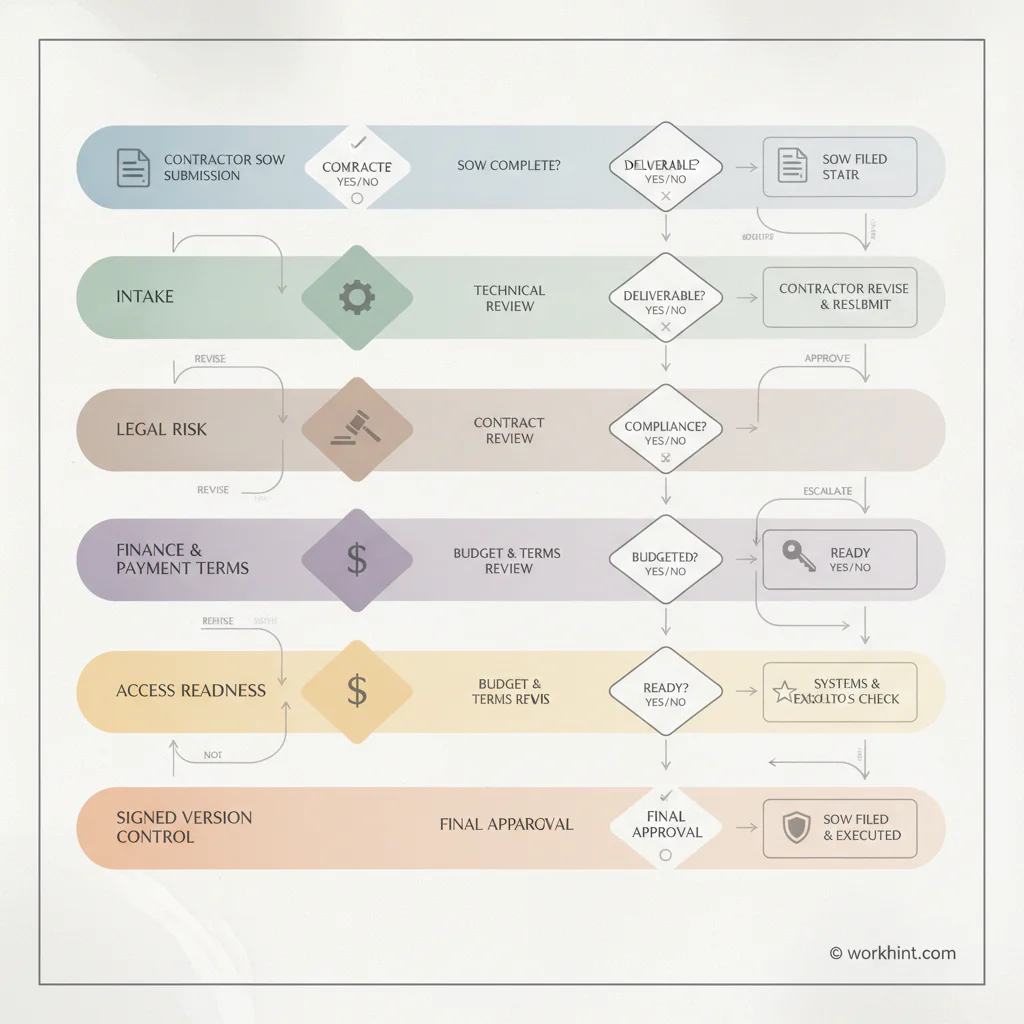
Use this workflow when a contractor, agency, consultant, implementation partner, or specialist vendor will deliver defined work under a project SOW.
- Intake the draft SOW. Require the requester to submit the draft, business outcome, contractor name, budget, timeline, deliverables, payment model, and the internal owner.
- Run a delivery feasibility review. The business owner or delivery lead checks whether deliverables, milestones, dependencies, and acceptance criteria are realistic.
- Check commercial terms. Finance or operations validates budget, payment schedule, invoice requirements, tax documentation status, and whether payment is tied to accepted work.
- Review legal and risk terms. Legal checks the master agreement relationship, IP ownership, confidentiality, liability, data handling, termination, and non-standard clauses.
- Confirm access and readiness. Operations, IT, or security confirms what systems, assets, credentials, and permissions the contractor needs, and when access should expire.
- Route exceptions. Non-standard pricing, unusual rights, customer data access, unclear acceptance criteria, or rushed timelines should go to the right approver before signature.
- Approve the final version only. The final approver should see the same SOW that will be sent for signature. Any later change should trigger reapproval.
- Store the executed SOW with metadata. Record the contractor, owner, start date, end date, milestones, payment triggers, access needs, and change-request path.
SOW Approval Roles and Checks
| Review lane | Primary owner | What to check | Approval output |
|---|---|---|---|
| Business fit | Requester or sponsor | Outcome, urgency, contractor fit, internal owner | Confirmed business reason |
| Delivery feasibility | Operations or delivery lead | Deliverables, milestones, dependencies, acceptance criteria | Feasible project plan |
| Finance | Finance or budget owner | Budget, pricing, payment triggers, invoice fields, currency | Payment-ready terms |
| Legal and risk | Legal or risk owner | IP, confidentiality, liability, termination, non-standard terms | Approved legal position |
| Access readiness | IT, security, or operations | Systems, data, permissions, asset needs, offboarding trigger | Access plan with limits |
| Final authorization | Engagement approver | All review lanes complete and final version locked | Approved SOW for signature |
What Should Be Approved Before Signature
Start with the work itself. Every deliverable should be specific enough that a person outside the project can understand what is being delivered. PMI’s contract guidance lists core elements such as scope, schedule, roles, pricing, payment, acceptance criteria, change request handling, termination, and dispute resolution. A contractor SOW does not need to be bloated, but it should prevent ambiguity.
Then approve the operating model. Who can request work? Who can approve changes? Who accepts a deliverable? What happens if the contractor misses a milestone or the company delays feedback? A SOW approval process should make these decisions visible before the project starts.
Finally, approve the payment path. Finance should be able to look at the SOW and know what makes an invoice payable. For milestone work, payment should connect to accepted deliverables. For hourly or retainer work, define approval rules, invoice requirements, and any expense policy.
How to Handle SOW Changes
Approving the original SOW is only half the system. Contractor work changes. The question is whether change is handled as a controlled decision or buried in email.
The Virginia SOW user guide treats a change request as the mechanism for documenting changes to scope, deliverables, schedule, fees, or pricing. That principle is useful outside public procurement too. If a change affects what will be delivered, when it will be delivered, who will approve it, or what it will cost, it should be documented as a change request or amendment.
A lightweight change request should include the original SOW reference, requested change, reason, timeline impact, cost impact, approving owner, contractor acknowledgment, and approval date. Larger teams may need routing rules by spend, risk, or customer impact.
Common SOW Approval Mistakes
- Approving scope without acceptance criteria. If “done” is not defined, every review becomes subjective.
- Letting finance see the SOW after signature. Payment issues should be resolved before the contractor invoices.
- Using one approver for every risk. A business sponsor may approve the outcome, but legal, finance, and security own different risks.
- Skipping version control. The signed SOW must match the approved SOW. Last-minute edits should trigger reapproval.
- Treating access as an afterthought. Contractors often need tools, files, data, and permissions. Access should be scoped, time-bound, and tied to offboarding.
Where Workhint fits
Workhint fits when the SOW approval process needs to become a repeatable workflow instead of a chain of emails and attachments. A team can use Workhint to collect SOW intake, assign review lanes, route approvals, track exceptions, store the approved version, and connect accepted milestones to invoice and payment status.
That is useful when a company works with multiple contractors, agencies, vendors, or implementation partners. Workhint helps separate requesters from approvers, keep permissions tied to each engagement, and maintain a record of scope, changes, deliverables, and payments without turning the process into a heavy procurement system.
FAQ
Who should own the statement of work approval process?
Operations, procurement, or the business systems owner should usually own the workflow. The business sponsor owns the outcome, legal owns contract risk, finance owns payment controls, and IT or security owns access requirements.
Does every contractor SOW need legal review?
Not always. Standard, low-risk SOWs under an approved master agreement may only need business and finance approval. Legal should review non-standard terms, customer data access, unusual IP language, high spend, international risk, or master agreement changes.
What is the difference between SOW approval and contract approval?
Contract approval usually focuses on legal and commercial terms. SOW approval focuses on whether the specific work is clear, feasible, funded, reviewable, and ready to execute under the contract.
How long should SOW approval take?
Simple SOWs can be approved in one or two business days if the intake is complete. Complex contractor projects may need a longer review, especially when legal terms, security access, pricing, or resource feasibility need discussion.
Conclusion
A strong SOW approval process protects the contractor relationship before work begins. It gives the contractor clear expectations, finance a payment basis, legal a risk record, and the business a way to approve work without confusion. The practical goal is simple: no contractor starts work until scope, owners, acceptance criteria, access, payment, and change control are clear.
Leave a Reply