

A Gemba walk only improves operations when real observations become owned actions, not when leaders collect notes and leave.
A Gemba walk is a practical way to understand how work actually happens before redesigning a workflow, writing an SOP, or automating a broken process. The term comes from lean management: the Lean Enterprise Institute describes gemba as the actual place where value is created and a Gemba walk as direct observation and inquiry before taking action.
What’s in this article?
- What a Gemba walk is and when to use one
- How to prepare without turning the walk into an inspection
- A practical checklist for observing workflow, handoffs, quality, and bottlenecks
- How to turn observations into owners, actions, and measurable improvement
- Where Workhint fits when the walk reveals a process that needs a real system
Why a Gemba walk matters
Teams often discuss operations from dashboards, tickets, meetings, or process maps. Those views are useful, but they can hide the friction people experience while doing the work: missing information, unclear priorities, duplicate entry, awkward handoffs, approval delays, or undocumented exceptions.
A Gemba walk brings leaders and process owners closer to the work. Lean guidance often summarizes the behavior as go see, ask why, show respect. That matters because the goal is not to catch people making mistakes. The goal is to understand the system they are working inside and remove friction that prevents better outcomes.
How to run a Gemba walk
Start with one process, one purpose, and one clear question. A broad walk through “operations” becomes vague fast. A focused walk through customer onboarding, invoice approval, field dispatch, contractor intake, support escalation, or fulfillment gives you something specific to observe and improve.
- Choose the workflow. Pick a process with visible business impact: delays, rework, customer complaints, missed SLAs, high manual effort, or unclear ownership.
- Define the purpose. Decide whether you are looking for bottlenecks, safety risks, quality defects, handoff gaps, automation opportunities, or training issues.
- Notify the team. Explain that the walk is about improving the system, not judging individual performance.
- Observe normal work. Watch the process while it is actually running. If the work is digital, observe the screen flow, notifications, data entry, and handoffs.
- Ask respectful questions. Start with what is happening, what information is needed, what slows the work down, and what people do when the normal path breaks.
- Capture facts, not opinions. Record wait times, missing inputs, repeated approvals, unclear ownership, exceptions, and workarounds.
- Close the loop. Share what you learned, assign follow-up owners, and track whether the change improved the process.
ASQ’s value stream mapping guidance similarly emphasizes gathering current-state data by going where the work happens, walking the flow, and interviewing the people who perform the task. That is the core discipline: understand reality before prescribing a better process.
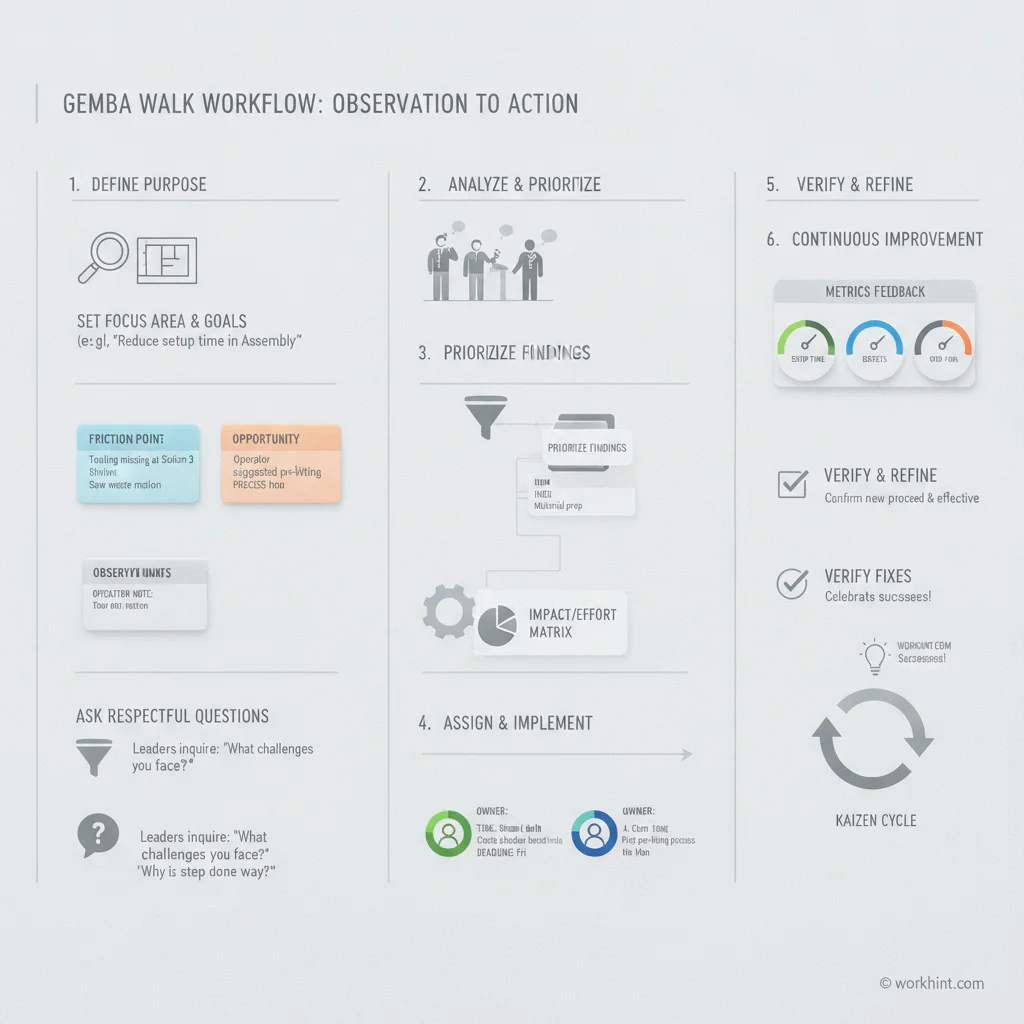
Gemba walk workflow: from observation to action
The walk itself is only the front end. The operating value comes from what happens after observation. Use a simple workflow that converts each finding into a trackable improvement record.
| Stage | Question to answer | Output |
|---|---|---|
| Purpose | What process are we trying to understand? | Defined workflow and improvement goal |
| Observation | What actually happens during normal work? | Facts, timing, handoffs, exceptions |
| Diagnosis | What system condition creates the friction? | Likely cause or investigation item |
| Ownership | Who can improve or investigate this? | Named owner and due date |
| Action | What change will be tested? | Improvement task, policy change, automation, or training update |
| Verification | Did the workflow improve? | Cycle time, error rate, wait time, quality, or satisfaction signal |
Gemba walk checklist
Use the checklist as a guide, not a script. The best questions depend on the process, but these categories work across most business operations.
- Purpose: Do the people doing the work know what outcome the process is meant to create?
- Inputs: Does work arrive with the information, approvals, documents, and context required to begin?
- Ownership: Is there one clear owner for each step, decision, and exception?
- Flow: Where does work wait, loop backward, or move through unnecessary handoffs?
- Tools: Are people switching between systems, copying data, or maintaining shadow spreadsheets?
- Quality: Where do errors appear, and how are they detected before customers or downstream teams are affected?
- Exceptions: What happens when a request is incomplete, urgent, nonstandard, or blocked?
- Measurement: Which signal shows whether the process is improving after changes are made?
Common mistakes to avoid
The most common mistake is treating the walk like an audit of people instead of an observation of the system. If participants feel inspected, they will perform the official process instead of showing the real one.
Another mistake is collecting too many observations without prioritizing them. A strong Gemba walk usually produces a small number of actionable findings. Separate quick fixes from structural workflow problems. A missing form field may be fixed in a day; a recurring approval delay may require new routing rules, ownership, escalation, or automation.
The third mistake is failing to verify impact. If a team changes the workflow but never checks cycle time, error rate, backlog age, or rework volume, the improvement becomes a belief rather than an operating fact.
Where Workhint fits
Workhint fits after the Gemba walk reveals that the process needs more than a note, meeting, or one-off fix. Teams can use Workhint to turn findings into a live work system: intake forms for observations, roles and permissions for owners, action queues for improvement work, approval steps for changes, dashboards for cycle time and open issues, and automation for reminders or escalations.
That keeps the Gemba walk connected to execution. Instead of documenting that customer onboarding stalls because information arrives incomplete, a team can build an intake workflow with required fields, owner routing, exception handling, and reporting. The observation becomes a system change.
FAQ
What is a Gemba walk?
A Gemba walk is a structured visit to the place where work happens so leaders and process owners can observe the real process, ask questions, and identify improvement opportunities before taking action.
How often should teams run Gemba walks?
Start with one focused walk per week for a high-priority process. Increase or reduce the cadence based on how quickly observations become useful actions and whether the team can follow through.
Can a Gemba walk work for remote or digital teams?
Yes. The “actual place” may be a support queue, CRM, shared inbox, dispatch board, workflow tool, or video walkthrough of someone completing the process. The principle is still direct observation of real work.
Who should attend a Gemba walk?
Include the process owner, someone close to the work, and any leader responsible for removing blockers. Keep the group small enough that the walk does not interrupt normal operations.
Conclusion
A Gemba walk is valuable because it forces process improvement to begin with reality. The best version is not a ceremonial leadership tour. It is a repeatable operating practice: observe the work, respect the people doing it, capture friction, assign owners, test improvements, and measure whether the workflow gets better.
Leave a Reply